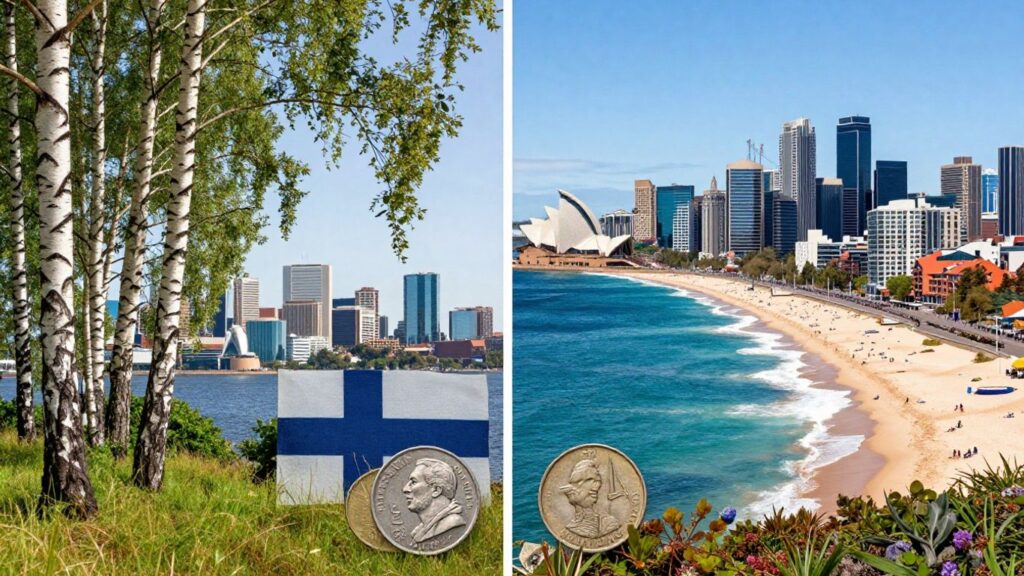
Thinking about where to live or just curious about how different countries stack up economically? This article takes a look at the Finland cost of living vs Australia. We’ll break down how the economies are doing, what it means for everyday people, and whether the ‘fair go’ is still a thing down under, all while keeping an eye on what’s happening up north in Finland. It’s a bit of a deep dive, but hopefully, it makes things clearer.
Key Takeaways
- Australia’s economy bounced back after the pandemic, but rising costs hit many households, especially younger and poorer folks, while wealthier Australians weathered the storm better.
- While Australia has a strong job market, income inequality has increased since the pandemic, partly due to government support being withdrawn and high inflation impacting real wages.
- Australia’s income inequality is about average compared to other wealthy nations, but wealth inequality is growing, particularly between older and younger generations.
- Finland, on the other hand, shows much lower inequality after taxes and transfers, suggesting policy choices significantly shape economic fairness.
- Australia’s ageing population and changing workforce demographics present future challenges for public services and the tax base, impacting the overall economic structure.
Understanding Economic Landscapes: Finland vs Australia
Right then, let’s get stuck into how Finland and Australia stack up economically. It’s not just about the price of a pint or a loaf of bread, is it? We’re talking about the bigger picture – how these countries are doing after all that pandemic craziness, what’s happening with prices and interest rates, and how strong their job markets are.
Post-Pandemic Economic Recovery
Both Finland and Australia have been navigating the choppy waters of post-pandemic recovery, but they’ve taken slightly different routes. Australia, with its reliance on resources and a strong domestic market, saw a bit of a bounce back, though things like supply chain hiccups and global demand have played their part. Finland, on the other hand, being more integrated into the European economy, has felt the ripples from its neighbours’ recoveries and challenges.
Inflationary Pressures and Interest Rate Shifts
Globally, inflation has been the big story, and these two countries are no exception. We’ve seen prices creep up, making everything from groceries to petrol cost more. Central banks in both nations have been tinkering with interest rates to try and get things under control. It’s a balancing act, really – you don’t want to slow the economy down too much, but you also don’t want prices running wild.
Here’s a rough idea of how things have been looking:
| Country | Inflation Rate (Approx. recent) | Official Cash Rate (Approx. recent) |
|---|---|---|
| Australia | 3.5% | 4.25% |
| Finland | 2.0% | 3.75% |
Note: These figures are indicative and can change rapidly. They reflect general trends observed in early 2026.
Labour Market Strength and Participation
When it comes to jobs, Australia’s labour market has been pretty solid, with participation rates hitting record highs. Lots of people who want a job, can find one. Finland’s labour market is also generally strong, though perhaps with slightly different dynamics due to its smaller size and different industry mix. A strong job market is good news for people’s wallets and for the economy overall, as it means more people are earning and spending.
The way people work and the jobs available are always changing. Things like new technology and global events mean economies have to adapt. It’s not just about having jobs, but about having the right jobs and making sure people can get them and do well.
It’s interesting to see how these economic foundations influence the everyday cost of living, which is what we’ll get into next.
Income Inequality: A Tale of Two Nations
Australia’s Income Distribution
When we talk about how money is spread around in Australia, it’s a bit of a mixed bag. For a while there, before the whole COVID thing, income inequality was pretty steady. Then, the pandemic hit, and the government stepped in with some serious support, like boosting JobSeeker and bringing in JobKeeper. This actually helped out folks on lower and middle incomes quite a bit, making things more even for a bit. But, as those supports wound back and inflation kicked in, a lot of those gains got reversed. High-income households, on the other hand, often did pretty well from business and investment income as things picked up.
Australia’s income inequality is generally considered to be in the middle of the pack when you compare us to other developed countries. We’re not as unequal as places like the US or the UK, but we’re also not as even as the Nordic countries. A big part of this comes down to our tax and welfare systems.
Here’s a rough idea of how Australia stacks up:
| Country | Gini Coefficient (Approx.) | Notes |
|---|---|---|
| Australia | 0.33 | Middle of the pack |
| USA | 0.41 | More unequal |
| UK | 0.35 | More unequal |
| Nordic Countries | 0.25 – 0.29 | More egalitarian |
Note: Gini coefficient measures inequality on a scale of 0 (perfect equality) to 1 (perfect inequality). Data can vary depending on the source and year.
Finland’s Egalitarian Approach
Finland, on the other hand, has a reputation for being pretty fair when it comes to income. Before taxes and government help, their income inequality is actually quite similar to Australia’s. But, after they apply their tax and transfer policies, Finland becomes one of the most equal countries in the OECD. This shows how much policy choices can really shape the outcome.
The Impact of Tax and Transfer Policies
It really comes down to the choices governments make. In Australia, while we have a ‘fair go’ ideal, the reality of income distribution is shaped by how we tax people and how we redistribute that money through welfare and services. Finland’s approach, with its strong social safety nets and progressive taxation, tends to level the playing field more effectively after all the numbers are crunched. This difference highlights that what might seem like technical economic decisions can have a big impact on people’s lives and the overall fairness of society.
The gap between the richest and poorest isn’t just about numbers; it affects people’s everyday experiences, their access to opportunities, and their overall quality of life. Understanding these differences is key to figuring out how we can build a fairer society.
Wealth Disparities and Generational Gaps
Growing Wealth Inequality in Australia
When we talk about wealth, it’s not just about how much money is in the bank. It’s about assets – houses, investments, superannuation – the whole lot. In Australia, while we often like to think of ourselves as a pretty equal place, the reality is that wealth isn’t spread around evenly. The gap between those who have a lot and those who have very little is noticeable.
Think of it like a ladder. For a lot of Australians, that ladder is pretty short. The top 10% are a fair way up, and the super-rich? Well, they’re practically in the clouds. It’s true that Australia’s wealth inequality isn’t as bad as some other developed countries, but it’s definitely something to keep an eye on. Things have been a bit of a rollercoaster, especially with the pandemic. For a while there, it looked like wealth was growing faster for the top half. But then, surprisingly, the pandemic actually helped boost wealth for lower and middle-income groups, mainly because house prices shot up and people had less to spend money on. Still, the long-term rise in house prices has created its own set of problems.
Generational Wealth Divide
This is where things get really interesting, especially when you look at different age groups. For decades, buying a house was a pretty standard part of life for young adults. But that’s changed. Home ownership rates for people in their early 30s have dropped significantly. For young people from lower-income families, it’s even tougher. This declining opportunity to own a home is a big source of frustration for many younger Australians. They want to own a place, but they’re not sure if they ever will.
This whole housing price boom has also really widened the wealth gap between generations. Older folks who already owned homes have seen their wealth grow a lot, thanks to rising property values. It’s like a windfall for them. On the other hand, the wealth of younger households, especially those under 35, hasn’t moved much at all over the last 15 years. And for poorer young Australians, they actually have less wealth now than their counterparts did 15 years ago. It’s a bit of a mixed bag, really. While many older Australians are doing very well, it’s come at a cost for younger generations who are facing more housing stress and are likely to own less property than their parents did.
Comparing Wealth Distribution Internationally
When you zoom out and look at how Australia stacks up against other countries, it’s a bit of a mixed picture. While Australia’s wealth inequality is generally lower than in many other OECD nations, it’s not exactly at the bottom of the pack either. The way wealth is distributed can be influenced by a lot of factors, including government policies and the structure of the economy. For instance, the impact of rising house prices has been a major driver of wealth for existing homeowners, which can create significant differences between generations. Understanding these international comparisons helps us see where Australia sits and what we might learn from other places. It’s a complex topic, and looking at data from places like OECD countries can give us a clearer idea of the trends.
The increasing cost of housing has become a major hurdle, particularly for younger generations trying to get a foot in the door. This isn’t just about owning a home; it affects overall financial security and the ability to build wealth over time. The dream of homeownership is becoming harder to reach for many.
Here’s a quick look at how wealth distribution can vary:
- Australia: Moderate wealth inequality, with a significant impact from housing prices on generational wealth.
- Finland: Generally lower wealth inequality compared to Australia, with a stronger emphasis on social safety nets.
- United States: Higher wealth inequality, with significant generational wealth gaps and a more pronounced impact of income on opportunity.
- Nordic Countries (e.g., Sweden, Denmark): Typically exhibit lower wealth inequality and higher social mobility, often supported by robust welfare systems.
Cost of Living Pressures on Households
Right, let’s talk about the elephant in the room – how much does it actually cost to live day-to-day in Finland versus Australia? It’s not just about the big ticket items like rent or a mortgage, but all those little things that add up. We’re seeing a fair bit of financial stress across the board, and it hits different people in different ways.
Financial Stress Across Income Brackets
It’s pretty clear that folks on lower incomes are feeling the pinch the most. When you’re already scraping by, any rise in prices for essentials like groceries, petrol, or electricity can be a real gut punch. Even those in the middle-income bracket aren’t immune; they might not be struggling to put food on the table, but they’re definitely noticing their savings aren’t stretching as far as they used to. This squeeze means less disposable income for things like hobbies, holidays, or even just a bit of breathing room.
Housing Costs and Rental Market Impacts
This is a big one, isn’t it? House prices have gone through the roof in both countries over the years, making it harder for people to get a foot in the door. For renters, it’s a constant battle. Rents keep climbing, and in some areas, finding a decent place at a price you can afford is like searching for a needle in a haystack. This isn’t just an inconvenience; it means people are spending a massive chunk of their income just to keep a roof over their heads, leaving less for everything else.
Vulnerable Groups Facing Hardship
Certain groups just seem to cop it harder than others. Think about single-parent families, people with disabilities, or those on fixed incomes like pensioners. They often have fewer resources to fall back on when prices go up. The rising cost of living can push them from just getting by to genuinely struggling. It’s a tough situation, and it highlights how important it is to have a solid social safety net in place.
The pressure on household budgets is a real concern. It’s not just about numbers on a spreadsheet; it’s about people’s everyday lives and their ability to plan for the future. When the cost of basic necessities keeps climbing, it leaves less room for savings, unexpected expenses, or even just enjoying life.
Here’s a quick look at how financial stress can stack up:
- Low-income households: Often struggle to cover basic needs like food and utilities. Rent or mortgage payments can take up more than half their income.
- Middle-income households: May find it harder to save, pay off debts, or afford non-essential items. They might be forced to cut back on leisure activities or postpone major purchases.
- Renters: Face higher and more volatile housing costs compared to homeowners, with less security and fewer options when prices rise.
- Pensioners and those on fixed incomes: Have limited ability to increase their income to match rising costs, leading to a decline in their standard of living.
Structural Economic Changes
Australia’s Ageing Population
Australia’s population is getting older, and that’s a pretty big deal for the economy. Think about it – more older folks means more demand for things like healthcare and aged care services. This isn’t just a small blip; it’s a major shift that’s already changing where government money goes and what jobs are around. We’re seeing a move towards more ‘human services’ jobs, which is great for some, but it also means we need to figure out how to deliver these services efficiently. Plus, with fewer people of working age supporting a larger older population, there’s a real question mark over how we’ll fund everything down the track.
Shifting Workforce Demographics
Beyond just age, the kind of work people are doing is changing too. The services sector, things like health, education, and retail, is taking up a bigger slice of the pie when it comes to jobs. This is pretty normal for a developed country, but it means our workforce needs to adapt. We’re needing more skilled workers, people who can do the thinking jobs rather than just the manual labour. This shift towards a more service-based and knowledge-driven economy is a big deal for how we train people and what skills are actually valuable. On top of that, we’ve got this massive push to go green, to decarbonise our economy. This means some industries, like coal mining, are going to shrink or disappear, while new ones, especially around renewable energy and new resources, will pop up. It’s a huge transformation, and our workforce needs to be ready for it.
Impact on Public Services and Tax Base
All these changes – the ageing population, the shift in jobs, and the green transition – put a real strain on our public services and how we collect taxes. When more people need healthcare and aged care, the costs go up. And if the workforce is changing, with maybe fewer people in traditional, high-taxing industries and more in services that might have different tax structures, our tax base can get a bit wobbly. We’re also seeing that productivity growth, the thing that really drives up living standards, has been a bit sluggish for a while now. This makes it harder to fund everything we want and need. It’s a bit of a balancing act, trying to keep services running smoothly and fairly while also making sure the government has enough money coming in to pay for it all. We need to be smart about how we use our existing infrastructure and be open to new ideas, especially with technology like AI potentially helping out in areas like healthcare.
The economy is always changing, and right now, Australia is dealing with some pretty significant shifts. An older population means more demand for care, while the move to green energy and a more service-focused job market means we need different skills. These aren’t small things; they affect how we fund public services and how much tax we collect. It’s a complex puzzle, and getting it right will be key to our future prosperity.
Navigating the ‘Fair Go’ Myth
We often hear about Australia being the ‘land of the fair go’. It’s a nice thought, isn’t it? The idea that everyone gets a fair crack at life, no matter where they start. But when you actually look at the numbers, and compare it to places like Finland, the picture gets a bit more complicated. Australia’s income inequality is pretty much bang in the middle when you compare it to other wealthy countries. We’re not as unequal as, say, the US or the UK, but we’re definitely not as even-steven as the Nordic countries. A big part of that difference comes down to how each country taxes its citizens and then redistributes that money.
Australia’s Middle-of-the-Pack Inequality
So, what does ‘middle of the pack’ actually mean? Well, using a common measure called the Gini coefficient, Australia sits pretty close to the average for OECD countries. This means that while we might not have the extreme highs and lows seen in some other nations, we’re certainly not a poster child for equality either. The gap between the highest and lowest earners is noticeable, and it’s something that’s been shaped by various economic factors over the years.
The Role of Social Safety Nets
When we talk about fairness, social safety nets – things like unemployment benefits, pensions, and family support – play a massive role. In countries like Finland, these systems are generally more robust and do a better job of levelling the playing field. They take income that’s already been earned and redistribute it more significantly. Australia has safety nets, of course, but they don’t always go as far in closing the gap. For instance, boosting payments like JobSeeker, while a good idea for those struggling, can be a tough sell politically and comes with a hefty price tag for the government.
Comparing Social Mobility
Social mobility is about how likely it is for someone to move up (or down) the economic ladder compared to their parents. While Australia has historically been seen as a place with good social mobility, recent trends suggest this might be changing. Things like the soaring cost of housing mean that fewer young people are able to own their own homes compared to previous generations. This can make it harder to build wealth and can lock people into certain economic circumstances. Finland, with its more egalitarian approach and stronger social support, often shows different patterns in how easily people can move between different income brackets over their lifetime.
The idea of a ‘fair go’ is deeply ingrained in the Australian identity, but the reality of economic outcomes shows a more mixed picture. While opportunities exist, structural factors and policy choices significantly influence how far those opportunities extend for everyone in the community.
So, Where Do We Stand?
Alright, so we’ve had a good look at how the cost of living stacks up between Finland and Australia. It’s not a simple ‘one’s cheaper than the other’ kind of deal, is it? Both places have their own quirks and costs, and what hits your wallet hard in one might be different in the other. Whether you’re thinking about packing your bags or just curious about how things compare, it’s clear that understanding these differences is key. It really comes down to what you’re after and where you’re at in life. Keep this stuff in mind when you’re planning, yeah?
Frequently Asked Questions
How has Australia’s economy recovered since the pandemic, and what’s the inflation situation like?
Australia’s economy has bounced back pretty well after the pandemic. Inflation, which is when prices go up, got quite high in 2022 and 2023. This was partly because of global stuff like energy prices and supply issues, but also because Aussies were spending a lot as things opened up. Thankfully, inflation has come down a lot, and interest rates are starting to drop, which is good news for most people.
Is Australia a fair place when it comes to income, or is there a big gap between rich and poor?
Australia is often called the ‘land of the fair go’, but the reality is a bit mixed. When you compare us to other rich countries, our income differences are pretty average. We’re not as unequal as places like the US or UK, but we’re also not as equal as the Nordic countries. Things like taxes and government support play a big part in how fair things are.
How does Australia compare to Finland when it comes to income inequality?
Finland is actually quite similar to Australia before taxes and government help are considered. But after taxes and support are factored in, Finland becomes one of the most equal countries out there. This shows that the choices governments make about policies really affect how equal a country is.
Are younger Australians doing it tougher than older Australians financially?
Yes, unfortunately, younger and poorer Australians have been hit harder by rising costs. Things like rent and interest on loans have gone up a lot, and many young people rely mainly on their wages. While older and wealthier Aussies haven’t seen their money situation change as much, younger people are having to cut back on spending.
What’s the deal with wealth differences between older and younger Australians?
There’s a growing gap in wealth between older and younger Aussies. Over the last few decades, older generations have ended up with much more wealth compared to younger ones. This is largely because of things like housing prices and superannuation savings, which have grown a lot over time.
How strong is Australia’s job market right now?
Australia’s job market is doing really well. Most people who want a job can find one, and a record number of people are working or looking for work. This is great news, especially for people who might have found it harder to get a job before, as it helps with financial security and feeling connected.