

Thinking about a move or just curious about how Melbourne, Australia stacks up against Washington D.C. in terms of everyday costs? It’s a common question for folks weighing their options. We’ve dug into the numbers to give you a clearer picture of the cost of living melbourne australia vs washington dc, looking at everything from rent to a loaf of bread. Let’s see which city might be easier on your wallet.
Key Takeaways
- Melbourne is generally cheaper than Washington D.C., with overall living costs around 31% lower.
- Housing expenses, both for renting and buying, are significantly less in Melbourne compared to Washington D.C.
- While groceries can be a bit more expensive in Melbourne, transport costs are lower, potentially balancing out daily spending.
- The average after-tax salary in Washington D.C. is higher, meaning your money might stretch a bit further there in terms of purchasing power, despite the higher costs.
- Both cities score very well for quality of life and have excellent air quality, but Melbourne is ranked higher as a place to live globally.
Overall Cost of Living Comparison
Melbourne vs. Washington: A Snapshot
When you’re weighing up where to live or even just visit, figuring out the cost of living is a biggie. Let’s get straight to it: Melbourne is generally a fair bit cheaper than Washington D.C. We’re talking a noticeable difference, not just a few bucks here and there. Based on recent data, you’d need significantly less cash to live comfortably in Melbourne compared to the US capital.
Here’s a quick look at how things stack up for a single person:
| Category | Melbourne (AUD) | Washington D.C. (USD) |
|---|---|---|
| Cost of Living (1 person) | $2,308 | $3,328 |
| Rent (1 bedroom apt) | $1,286 | $2,171 |
| Groceries (monthly) | $561 | $759 |
| Transport (monthly) | $315 | $156 |
As you can see, rent and groceries are quite a bit higher in Washington. Transport costs are surprisingly lower in D.C., though, which is interesting.
It’s always a good idea to remember that these figures are averages. Your own spending habits will play a huge role in your actual expenses. What one person considers essential, another might not. So, take these numbers as a guide, not gospel.
Purchasing Power Parity
Purchasing Power Parity, or PPP, is a way to compare how much money can actually buy in different places. It’s not just about the exchange rate; it’s about what your dollar (or your Aussie dollar) is worth on the ground. In this comparison, Melbourne generally comes out ahead. This means that for the same amount of money, you can often buy more goods and services in Melbourne than you can in Washington D.C. It’s a bit of a complex economic idea, but basically, it suggests that your money goes further in Melbourne.
Global City Rankings
Both Melbourne and Washington D.C. are recognised as major global cities, but they often appear in different leagues when it comes to cost of living indexes. Melbourne frequently pops up in lists of the world’s most liveable cities, often ranking very highly. Washington D.C., while a significant city, usually sits much lower on these specific cost-of-living rankings, often appearing as one of the more expensive cities in the US and globally. This difference in ranking reflects the broader economic and cost structures of each city.
Housing Expenses: Rent and Ownership
When you’re thinking about where to live, housing costs are usually a big part of the picture. It’s no different when comparing Melbourne and Washington D.C. Let’s break down what you can expect to pay for a place to call home in each city.
Rental Costs: Apartments in the City Centre
Finding a place right in the heart of the city can be appealing, but it often comes with a higher price tag. In Melbourne, renting a one-bedroom apartment smack bang in the CBD will set you back around A$2,461 per month. If you’re looking for more space, a three-bedroom place in the centre jumps up to about A$4,756 monthly. Washington D.C. is generally more expensive here. A similar one-bedroom in D.C.’s centre averages about US$2,659 (roughly A$3,809), and a three-bedroom can cost upwards of US$5,335 (around A$7,643) each month. So, if city living is your jam, Melbourne looks a fair bit cheaper for rent.
Rental Costs: Apartments Outside the City Centre
Sometimes, living a bit further out from the hustle and bustle is the way to go. It can often mean more space for your dollar. In Melbourne, a one-bedroom apartment outside the centre goes for about A$1,827 a month, and a three-bedroom is around A$3,403. Washington D.C. still tends to be pricier, even when you’re not right in the middle. A one-bedroom outside the centre there is roughly US$2,099 (about A$3,007) per month, and a three-bedroom could be around US$4,351 (approximately A$6,233). The trend continues: Melbourne offers more affordable rental options when you move away from the absolute core.
Apartment Purchase Prices
Buying property is a whole different ballgame. When looking at the price per square foot to buy an apartment in the city centre, Melbourne comes in at about A$982 per square foot. Washington D.C. is a bit higher, averaging around US$800 (roughly A$1,147) per square foot. However, things get really interesting when you look outside the city centre. In Melbourne, buying a place outside the centre costs about A$851 per square foot. But in Washington D.C., the price per square foot plummets to around US$302 (approximately A$433). This is a massive difference, suggesting that if buying property is your goal, and you’re open to living further out, Washington D.C. could actually be significantly cheaper per square foot than Melbourne.
The property market dynamics between these two cities show a clear pattern: inner-city living is more expensive in Melbourne, but the cost of buying property further from the centre can be dramatically lower in Washington D.C. This might influence whether you prioritise location or overall purchase price.
Here’s a quick look at the rental differences:
| Type of Apartment | Melbourne (A$) | Washington D.C. (US$) | Washington D.C. (A$) | Difference (Melbourne vs DC) |
|---|---|---|---|---|
| 1 Bed, City Centre | 2,461 | 2,659 | 3,809 | Melbourne is 35.4% cheaper |
| 1 Bed, Outside Centre | 1,827 | 2,099 | 3,007 | Melbourne is 39.2% cheaper |
| 3 Bed, City Centre | 4,756 | 5,335 | 7,643 | Melbourne is 37.8% cheaper |
| 3 Bed, Outside Centre | 3,403 | 4,351 | 6,233 | Melbourne is 45.4% cheaper |
Daily Living Expenses
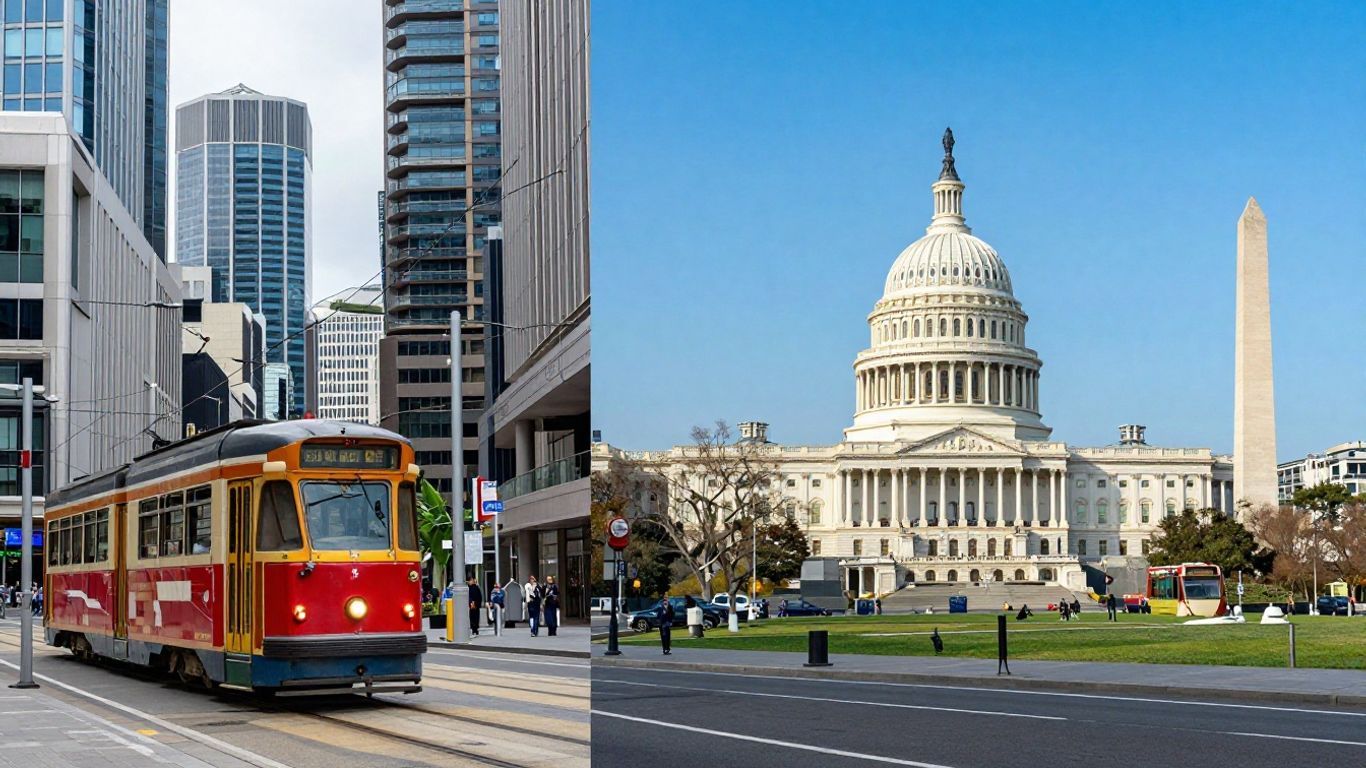
Alright, let’s get down to the nitty-gritty of what it actually costs to live day-to-day in Melbourne versus Washington D.C. This is where you really feel the pinch, or maybe get a bit of a breather, depending on where you’re calling home.
Groceries and Food Costs
When it comes to stocking your fridge and pantry, things can add up pretty quickly. We’re talking about your everyday essentials, from milk and bread to fruit and veggies. It’s interesting to see how these costs stack up between the two cities.
| Item | Melbourne (A$) | Washington D.C. ($) | Difference |
|---|---|---|---|
| Milk (1 Litre) | $1.50 | $1.05 | -30.0% |
| Loaf of Fresh White Bread | $3.50 | $2.50 | -28.6% |
| Rice (1kg) | $2.50 | $2.00 | -20.0% |
| Eggs (12 pack) | $4.50 | $3.50 | -22.2% |
| Apples (1kg) | $4.00 | $3.00 | -25.0% |
| Chicken Breast (1kg) | $12.00 | $9.00 | -25.0% |
| Imported Beer (0.33L Bottle) | $4.50 | $3.28 | -27.1% |
| Cigarettes (Pack of 20) | $35.00 | $13.94 | -60.1% |
Keep in mind that these are average prices, and shopping at local markets or choosing store brands can often bring these costs down further in either city.
Transportation Expenses
Getting around is a big part of daily life, and how much you spend on it can really make a difference to your budget. Whether you’re relying on public transport, hopping in a taxi, or filling up your car, there are some notable differences.
- Public Transport: A monthly pass in Melbourne will set you back more than in D.C. It’s a significant difference if you’re a regular commuter.
- Taxis: While the initial fare might be a bit higher in D.C., the cost per mile tends to be cheaper than in Melbourne. Waiting time, however, is more expensive in Melbourne.
- Fuel: If you own a car, you’ll find petrol prices are considerably higher in Melbourne.
| Item | Melbourne (A$) | Washington D.C. ($) | Difference |
|---|---|---|---|
| One-Way Ticket (Local Transport) | $5.50 | $4.08 | -25.8% |
| Monthly Public Transport Pass | $199.00 | $168.33 | -15.4% |
| Gasoline (1 Litre) | $1.85 | $1.26 | -32.1% |
Clothing and Footwear
Buying clothes and shoes is one of those expenses that can vary wildly depending on what you’re after. However, looking at some common items gives us a general idea.
- Jeans: You’ll generally pay a bit more for a pair of Levi’s in Melbourne.
- Running Shoes: If you’re a runner, expect to spend more on a mid-range pair of Nike shoes in Melbourne.
- Business Shoes: On the flip side, men’s leather business shoes are actually cheaper in Melbourne.
It seems like for everyday casual wear, Melbourne might be a touch more expensive, but for more formal items, it can swing the other way. The cost of clothing and footwear is quite varied between the two cities.
Income and Salary Insights
Average Monthly Net Salary
When we look at what people actually take home after tax, there’s a pretty noticeable difference between Melbourne and Washington D.C. On average, folks in Washington D.C. are earning more each month. This is a significant point to consider because it directly impacts how much disposable income you have for everyday expenses and savings.
| City | Average Monthly Net Salary (AUD) | Average Monthly Net Salary (USD) |
|---|---|---|
| Melbourne | $6,116.62 | $4,269.64 |
| Washington, D.C. | $8,828.43 | $6,162.59 |
As you can see, the difference is quite substantial, with Washington D.C. salaries being considerably higher. This doesn’t automatically mean life is easier there, though, as we’ve seen housing and other costs can be higher too.
Salary Adjustment Considerations
It’s not just about the raw numbers, though. You’ve got to think about what that money can actually buy you in each city. Purchasing power parity is a fancy way of saying how far your dollar (or your Aussie dollar) stretches. Even though Washington D.C. has higher average salaries, the cost of living, especially for things like rent, is also much higher. This means that while you might earn more on paper, your money might not go as far as you’d expect.
Here are a few things to keep in mind:
- Exchange Rates: Obviously, the AUD to USD exchange rate plays a big role if you’re comparing directly.
- Localised Costs: Some things might be cheaper in one city than the other, even with different salary levels. Think about groceries, public transport, or even a night out.
- Career Opportunities: The type of work you do and the industry you’re in will heavily influence salary expectations in both cities.
The average after-tax salary in Melbourne allows someone to cover their living expenses for about 1.8 months. In Washington D.C., this figure is slightly higher, at around 1.9 months. This suggests that while Melbourne might be cheaper overall, the salary difference means the purchasing power is quite comparable when you factor in daily costs.
Beyond the Numbers: Quality of Life

So, we’ve crunched the numbers on rent, groceries, and all that jazz. But what about the stuff that doesn’t show up on a spreadsheet? Life’s more than just dollars and cents, right? Let’s chat about what it’s actually like to live in Melbourne versus Washington D.C., beyond the price tags.
Quality of Life Index
When you look at overall quality of life, Melbourne actually scores pretty well, often topping lists for liveability. It’s got that reputation for being a pretty good place to hang out. Washington D.C. isn’t far behind, but Melbourne generally edges it out in these kinds of rankings. It’s not a massive difference, but it’s there.
Air Quality and Environment
This is a big one for a lot of people. Melbourne tends to have pretty decent air quality, especially when you get out of the absolute centre. It’s got a lot of green spaces and is known for being a bit cleaner overall. Washington D.C. is okay, but it’s a much busier, more built-up city, and you can sometimes feel that in the air, especially closer to the traffic.
Higher Education Accessibility
Both cities have solid options for higher education. Melbourne is home to some world-class universities, and you’ll find a good mix of public and private institutions. Washington D.C. also has a strong university scene, with many well-regarded schools. For sheer number and perhaps global reputation in certain fields, Melbourne often gets a nod, but both offer plenty for students.
It’s easy to get caught up in the cost of things, but sometimes the intangible aspects of a city make all the difference. Think about things like how easy it is to get around without a car, the general vibe of the place, and whether you feel safe walking around at night. These things can really impact your day-to-day happiness, and they’re hard to put a dollar value on.
Here’s a quick look at how they stack up on some lifestyle factors:
- Green Spaces: Melbourne has a fantastic network of parks and gardens, like the Royal Botanic Gardens and Fitzroy Gardens, making it easy to escape the urban hustle. Washington D.C. has its National Mall and Rock Creek Park, which are great, but perhaps less integrated into the everyday fabric for many residents.
- Public Transport: Melbourne’s tram system is iconic and covers a lot of ground, making it pretty easy to get around without a car. Washington D.C.’s Metro is efficient but might not feel as extensive or as central to daily life for as many people compared to Melbourne’s trams.
- Cultural Scene: Both cities offer a lot, but Melbourne is often praised for its vibrant arts, music, and food scene, with countless laneway cafes and bars. Washington D.C. has its world-class museums and historical sites, offering a different kind of cultural experience.
When you’re weighing up where to live, don’t forget to think about what kind of lifestyle you’re after. Are you someone who thrives on the buzz of a major capital with all its historical weight, or do you prefer a city that feels a bit more laid-back, with easy access to nature and a strong community feel? That’s the stuff that really matters.
So, Which City Wins on Price?
Alright, so we’ve crunched the numbers, and it looks like Melbourne is definitely the more budget-friendly option compared to Washington DC. Everything from rent to groceries seems to cost less down under. While Washington might have a slight edge in some areas like transport costs, the overall picture shows Melbourne coming out on top for saving your hard-earned cash. If you’re looking to stretch your dollar further, Melbourne seems like the way to go. It’s not a massive difference in every single thing, but when you add it all up, it’s pretty clear where you’ll get more bang for your buck.
Frequently Asked Questions
So, which city is actually cheaper to live in?
Overall, Melbourne is quite a bit cheaper than Washington D.C. You’d be looking at spending about 31% less in Melbourne. This means your money would stretch further there.
Is rent a big difference between the two cities?
Yes, rent is a major difference! It’s much cheaper to rent a place in Melbourne. For example, a one-bedroom apartment in the city centre costs way less in Melbourne than in Washington D.C. Even places outside the centre are significantly cheaper in Melbourne.
What about buying a place? Is that cheaper in Melbourne too?
It depends on where you’re looking. Buying an apartment in the city centre is a bit more expensive per square foot in Washington. However, if you look outside the city centre, buying a place in Melbourne is actually much more expensive per square foot compared to Washington.
How do everyday costs like food and transport stack up?
Groceries and food tend to be cheaper in Melbourne. On the flip side, transport costs are a lot lower in Washington D.C. So, while food might save you money in Melbourne, getting around could cost you more.
If I earn money in these cities, how much can I buy?
Even though the average salary after tax is higher in Washington, Melbourne’s lower cost of living means your money can go further. You can cover your living expenses for about 1.8 months with an average Melbourne salary, compared to 1.9 months in Washington. It’s pretty close, but Melbourne’s cheaper prices help.
Which city is considered better for living?
Both cities are highly rated! Melbourne often gets top marks for quality of life and is considered one of the best cities to live in, not just in Australia but globally. Washington D.C. also scores well for quality of life, but Melbourne generally comes out slightly ahead in these rankings.