
Key Takeaways
Choosing a 26650 battery is mostly a matter of matching the cell to the device, charger and way you use it.
- Check the device’s required voltage, current and physical battery format before buying.
- Capacity affects runtime, while discharge rating affects how well a cell handles demanding loads.
- Protected and unprotected cells suit different devices and user experience levels.
- Charge lithium-ion cells with a compatible charger on a stable, non-flammable surface.
- Remove damaged, swollen, leaking or unusually hot batteries from service promptly.
What is a 26650 battery?
A 26650 battery is a cylindrical rechargeable cell commonly used where a larger physical format and high energy storage are useful. The name describes the approximate dimensions, not a single chemistry or performance level. Different cells can have very different capacities, discharge ratings and protection circuits. Reading the full specification matters more than relying on the size printed on the wrapper.
Understanding the 26650 size designation
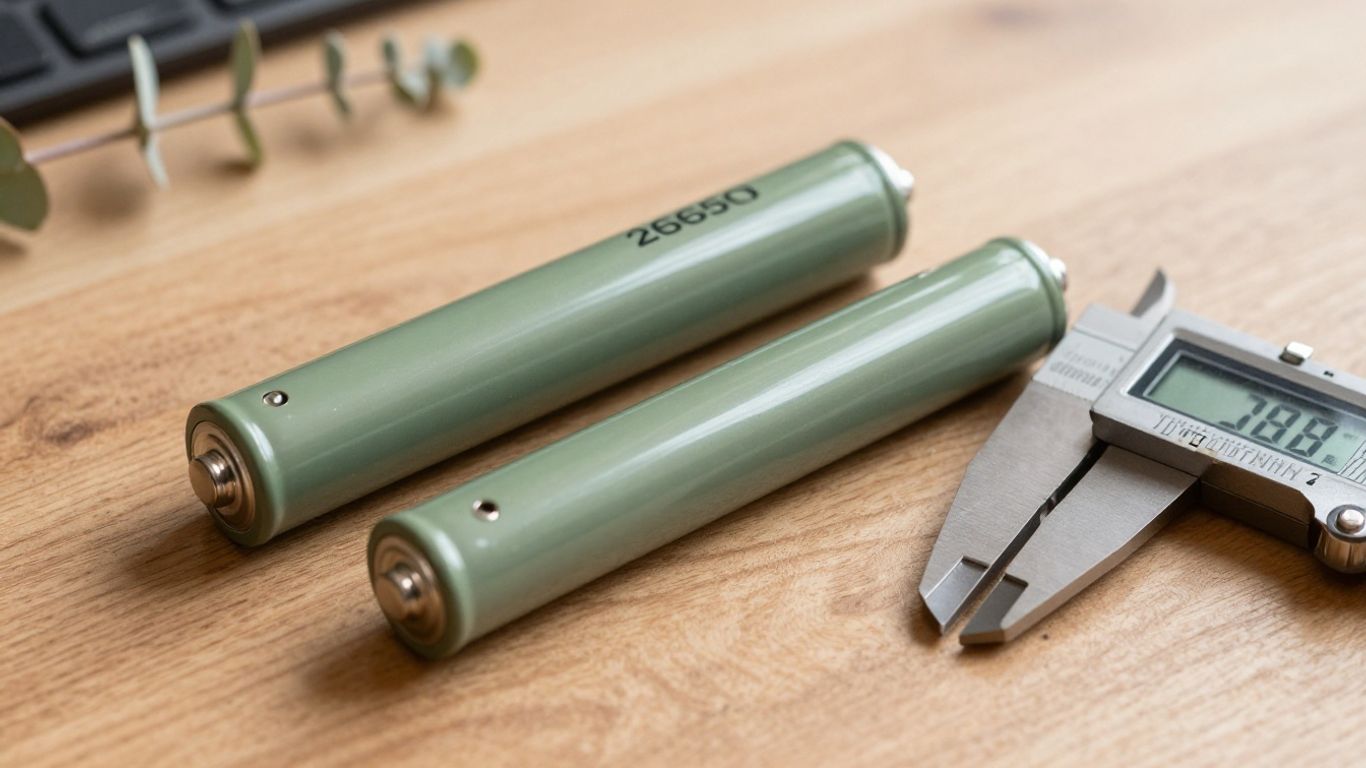
The “26” generally refers to a diameter of about 26 millimetres, while “65” refers to a length of about 65 millimetres. The final zero indicates a cylindrical shape. Actual finished cells can be slightly longer or wider once a wrapper, protection circuit or button terminal is added, so the nominal dimensions are only a starting point. A device designed around a bare cell may not accept a protected version.
Common lithium-ion chemistries and formats
Most cells sold as 26650 batteries use a lithium-based rechargeable chemistry, but chemistry still needs checking. Lithium-ion and lithium iron phosphate cells have different voltage ranges and must not be treated as interchangeable. Cells may also be sold as flat-top or button-top, protected or unprotected, and individually or as matched sets. A charger and device must support the particular chemistry rather than simply the physical size.
Typical voltage, capacity and discharge ratings
A conventional 26650 lithium-ion cell is often described with a nominal voltage around 3.6 or 3.7 volts, although its voltage changes during use and charging. Capacity is measured in milliamp-hours and gives a broad indication of runtime. Discharge ratings describe how much current the cell can provide, but marketing terms such as “high drain” are not enough on their own. Check the manufacturer’s continuous rating and the test conditions behind it.
How 26650 cells compare with 18650 and 21700 batteries
An 18650 is narrower, while a 21700 is generally narrower than a 26650 but often longer than an 18650. Physical size affects the available capacity and the space needed inside the device, but it does not guarantee better performance. A device built for one format may have different contacts, springs or protection requirements. Never substitute a larger cell simply because it appears to offer more capacity.
How to check 26650 battery compatibility
Compatibility is a three-part check: electrical characteristics, physical fit and safe operation. A cell can look correct and still be unsuitable if its voltage range or current capability does not match the equipment. Before ordering, locate the device manual or the manufacturer’s label and compare it with the complete battery datasheet. This is more dependable than choosing by capacity alone.
Matching the battery to your device
Start with the device’s stated battery format and chemistry. Some torches accept only a particular length, while some electronics require a protected cell or a specific terminal style. If the manual says “26650”, confirm whether that means a flat-top, button-top, protected or unprotected version. For Australian e-bike owners, broader battery-care guidance such as this e-bike battery safety guide is useful, but it does not replace the battery maker’s instructions.
Checking voltage and current requirements
Compare the cell’s nominal and maximum charging voltage with the device’s requirements. Also consider the current drawn under normal and peak conditions. A cell with plenty of capacity may still be unsuitable if its continuous discharge rating is too low. Conversely, buying the highest claimed current rating is unnecessary when the equipment draws only a modest load.
Comparing protected and unprotected cells
A protected cell includes a small electronic circuit intended to help manage conditions such as overcharge, over-discharge or excessive current. An unprotected cell relies more heavily on the device and charger for those controls. Protection adds length and can affect fit, so it is not automatically the right choice. Follow the equipment instructions and avoid placing unprotected cells in devices that do not provide suitable safeguards.
Confirming dimensions, terminals and fit
Measure the battery compartment if the manufacturer does not provide a clear compatibility list. Check diameter, length, contact arrangement and whether the positive terminal is raised. Springs and magnetic contacts can make a close fit unsafe if the cell can shift or bridge terminals. The battery should sit securely without force, rattling or pressure that could damage the wrapper.
How to choose the best 26650 battery
There is no universal “best” 26650 battery. The right option depends on runtime, load, space, charging arrangements and the consequences of a failure. Compare independent specifications where possible, and be cautious with cells that make unusually large claims without a datasheet. A modest, clearly documented cell is often a better purchase than an impressive label.
Balancing capacity and runtime
Higher capacity can extend runtime, but capacity is only useful if the cell can safely deliver the required current. Real runtime also depends on temperature, age, device efficiency and how deeply the cell is discharged. For a low-drain application, capacity may be the priority. For a demanding application, a slightly lower-capacity cell with a credible discharge rating may perform more reliably.
Evaluating continuous and peak discharge ratings
Give more weight to the continuous discharge rating than to a brief peak figure. Peak ratings can describe a short pulse under specific test conditions and may not reflect sustained use. Compare the device’s maximum draw with a sensible safety margin, rather than operating permanently at the cell’s limit. Use the continuous rating first when comparing otherwise similar batteries.
Identifying reputable brands and genuine specifications
Buy from a seller that provides a model number, chemistry, dimensions, capacity and discharge information. A product listing should make clear whether the stated current is continuous or temporary. For example, the UltraFire 26650 Rechargeable Battery listing documents a protected 5000mAh, 3.7V, 10A cell for high-drain devices; those details should still be checked against the equipment before purchase. Avoid loose cells with damaged wrappers or labels that do not match the seller’s documentation.
Choosing between flat-top and button-top cells
Flat-top cells have a level positive end and are common in battery packs and devices with spring contacts. Button-top cells have a raised positive terminal and may be required by equipment with recessed contacts. The difference is small but decisive: the wrong terminal may fail to make contact or may create an unsafe fit. Do not add improvised spacers or magnets unless the device manufacturer explicitly allows them.
How to charge a 26650 battery safely
Charging deserves the same care as choosing the cell. Use a charger that recognises the chemistry and applies the correct voltage and charging method. Charge one cell at a time unless the charger and battery arrangement are specifically designed for a matched pack. Stay nearby while charging and stop if the cell becomes unusually hot, smells odd or changes shape.

Selecting a compatible charger
Choose a charger that explicitly supports 26650 cells and the chemistry being used. Some chargers accept several cylindrical sizes, while others have limited bay lengths or terminal travel. Do not rely on a USB lead or a generic power adaptor unless it is part of a charger designed for that exact battery system. The Orbtronic battery and charger range illustrates why model-level details, including chemistry and cell format, need to be checked rather than assumed.
Setting the correct charging mode and current
Select the correct chemistry mode and use the charging current recommended by the cell maker or charger instructions. A faster setting is not necessarily better, particularly for an older cell or a high-capacity battery. Place the charger on a hard, stable surface with ventilation and keep it away from bedding, paper and direct heat. Never charge a cell that is hot from use until it has cooled and been inspected.
Inspecting cells before and after charging
Look for torn wrappers, dents, corrosion, leakage and abnormal heat before placing a cell in the charger. After charging, check that it is not swollen, wet or noticeably hotter than expected. A charger stopping normally does not prove that a physically damaged cell is safe. Keep an eye on cells that show a sudden change in charging time or runtime.
A useful charging demonstration can help new users recognise correct bay placement and warning signs, but visual guidance should support—not replace—the charger and battery instructions.
Knowing when a battery should be removed from service
Retire a cell if it is swollen, leaking, badly dented, deeply discharged, repeatedly overheating or showing a damaged wrapper near either terminal. Do not attempt to repair a compromised lithium-ion cell or place it in household rubbish. Isolate it from metal objects and seek advice from a battery recycler or local council about the safest disposal route.
26650 battery safety essentials
Lithium-ion cells store substantial energy in a compact package. Most problems arise from short circuits, incorrect charging, physical damage or unsuitable combinations of cells and equipment. Good habits are simple, but they need to be consistent. Treat loose cells as electrical components rather than harmless accessories.
Preventing short circuits and overheating
Keep spare batteries in a rigid plastic case that prevents contact between terminals. Do not carry a loose cell in a pocket, bag or drawer with keys, coins or tools. Stop using a device if the battery compartment becomes excessively hot, and do not cover a charging unit while it is operating. Heat that cannot escape can shorten cell life and increase risk.
Avoiding damaged, swollen or leaking cells
A wrapper is an insulating barrier, not decoration. Replace a cell if the wrapper is torn, the insulating ring is missing or the metal can is dented. Swelling, liquid residue or a sharp chemical smell are reasons to stop handling the cell unnecessarily. Do not puncture, squeeze, open or place a damaged battery in water.
Storing batteries at a suitable charge level
For storage lasting more than a few days, follow the cell maker’s advice rather than leaving the battery permanently full. A cool, dry place away from direct sun is preferable, with cells stored in protective cases and kept out of reach of children. Check stored batteries periodically for corrosion, swelling or accidental discharge. Avoid storing them in a hot car or shed during Australian summer.
Transporting and recycling lithium-ion batteries in Australia
Transport loose cells in a case that prevents movement and terminal contact. For flights, check the airline’s current rules before travelling; spare lithium batteries are generally subject to specific cabin and protection requirements. At the end of life, use a council facility, battery collection point or retailer service that accepts rechargeable batteries. Never put loose lithium-ion cells in kerbside bins.
Where 26650 batteries are commonly used
The 26650 format appears in equipment that has room for a larger cylindrical cell and needs useful energy storage or current delivery. Its suitability depends on the individual product, not just the application category. A torch, vape device or battery pack may each require a different chemistry, terminal style or protection arrangement. Check the original equipment specification before treating a replacement as universal.
High-output torches and portable lighting
Some high-output torches use 26650 cells because the larger format can provide useful capacity in a body designed around it. Runtime and brightness depend on the torch’s driver, thermal management and battery requirements. A protected cell may be necessary in one torch and physically unsuitable in another. Avoid assuming that a cell advertised for a torch is safe in every torch.
Vaping devices and high-drain electronics
High-drain electronics can place demanding loads on a cell, making the continuous discharge specification especially important. Use only the battery type recommended by the device manufacturer and inspect the wrapper frequently. Never use a loose cell with damaged insulation in a vaping device. If the equipment becomes hot, stop using it and investigate rather than continuing to draw power.
Battery packs, tools and mobility equipment
Battery packs require cells with compatible characteristics, not simply matching dimensions. Cells connected in series or parallel should be appropriately matched and managed by a suitable battery-management system. For mobility equipment, replacement work is best handled by a qualified technician when the pack is sealed or high voltage. General battery care for e-bikes can help with everyday checks, though a 26650 pack may have different service requirements.
DIY projects and replacement applications
DIY projects should begin with a clear electrical design, an enclosure that prevents movement and protection appropriate to the chemistry. Do not mix cells from different models or combine old and new cells casually. A replacement battery is only suitable when its voltage, current capability, dimensions and terminal arrangement all match. The 26650 battery selection page can provide a starting point for understanding the category, but the device specification remains decisive.
How to maintain and troubleshoot a 26650 battery
Maintenance is mostly observation and restraint. Keep contacts clean and dry, avoid unnecessary deep discharges, and record unusual changes in runtime or temperature. A battery that suddenly behaves differently deserves attention before it is used again. Troubleshooting should never involve bypassing a protection circuit or opening a cell.
Improving battery life through proper use
Use the correct charger, avoid extreme heat and do not leave a battery fully discharged for long periods. Allow a hot cell to cool before charging and remove it from equipment that will not be used for an extended time. Keeping the wrapper intact and the contacts clean also reduces avoidable stress. These small habits usually matter more than chasing a claimed maximum cycle count.
Diagnosing reduced runtime and voltage drops
Reduced runtime may come from natural ageing, cold conditions, a dirty contact, a demanding device or a charger that has not fully charged the cell. Voltage dropping quickly under load can indicate rising internal resistance or a mismatch between the cell and equipment. Compare the behaviour with a known-good, compatible cell only if doing so is safe. If the battery becomes hot or the voltage behaves erratically, stop testing and retire it.
Managing batteries used in pairs or packs
Cells used together should be the same model, chemistry, capacity and approximate age, ideally purchased and maintained as a matched set. Keep paired cells together and charge them using equipment designed for the arrangement. Do not separate a pack casually or substitute one cell after another has failed. Uneven cells can become increasingly unbalanced during use and charging.
Replacing cells without mixing incompatible batteries
Do not mix different capacities, brands, chemistries, ages or protection arrangements in one pack. If a pack needs replacement, follow the original design and use a qualified repairer where spot welding, insulation or a battery-management system is involved. A loose replacement that fits the compartment may still be electrically wrong. When in doubt, replace the complete approved pack rather than improvising.
Conclusion
A 26650 battery can provide dependable service when its chemistry, voltage, discharge capability, physical format and charger all match the equipment. Check those details before buying, protect loose cells from short circuits, and retire anything damaged or unusually hot. A careful match is more valuable than the biggest capacity claim on the label.
Frequently Asked Questions
Is a 26650 battery rechargeable?
Many 26650 batteries are rechargeable lithium-based cells, but the exact chemistry and charging method must be confirmed from the label or datasheet. Never assume that every cell with the same size can use the same charger.
What voltage is a 26650 battery?
A conventional lithium-ion 26650 cell is commonly described as having a nominal voltage around 3.6 or 3.7 volts. Its actual voltage varies during discharge and charging, so the device’s full voltage requirements must also be checked.
Can I replace an 18650 with a 26650 battery?
Usually not. The two formats have different dimensions and may require different contacts, holders and electrical specifications. Use only the size and chemistry approved for the device.
Are protected 26650 batteries safer?
A protection circuit can help manage certain electrical fault conditions, but it does not make an unsuitable cell safe. Protection may also change the battery’s dimensions, so compatibility still needs to be confirmed.
How long does a 26650 battery last?
Runtime depends on capacity, device power demand, temperature and battery condition. Service life also varies with charging habits, storage and the number of cycles. A sudden drop in runtime can signal ageing or a fault.
Can I charge a 26650 battery overnight?
It is better to charge while you are present, using a compatible charger on a clear, stable surface. Stop charging if the cell becomes unusually hot, smells abnormal or shows physical damage.
How should I dispose of a 26650 battery in Australia?
Take rechargeable lithium-ion cells to a suitable battery collection point, council facility or retailer recycling service. Keep terminals protected during transport and never place loose cells in household rubbish or recycling bins.