
So, you want to get better at swimming, huh? A lot of people think it’s all about your arms, but honestly, your kick is a pretty big deal. It helps you move forward and keeps you from sinking like a stone. We’re going to look at how to really nail that kick, from the basics to some more advanced stuff. Whether you’re just starting out or you’ve been swimming for a while, getting your kick right can make a huge difference. Let’s dive in and learn to swim better, one kick at a time.
Key Takeaways
- Focus on a hip-driven flutter kick with straight legs and pointed toes, avoiding excessive knee bend for maximum propulsion.
- Practice drills like vertical kicking, side kicking, and wall kicking to build power, improve rotation, and refine technique without breathing interruptions.
- Integrate kick practice into your routine with warm-ups, dedicated kick sets, and by mixing intensities to build both strength and technical skill.
- Supplement your pool training with dryland exercises for flexibility, strength, and ankle conditioning to support a more powerful kick.
- Utilise equipment like kickboards and fins strategically to isolate and improve your kick, while pull buoys can highlight the kick’s contribution to your overall stroke.
Understanding The Perfect Flutter Kick
The Anatomy Of An Effective Kick
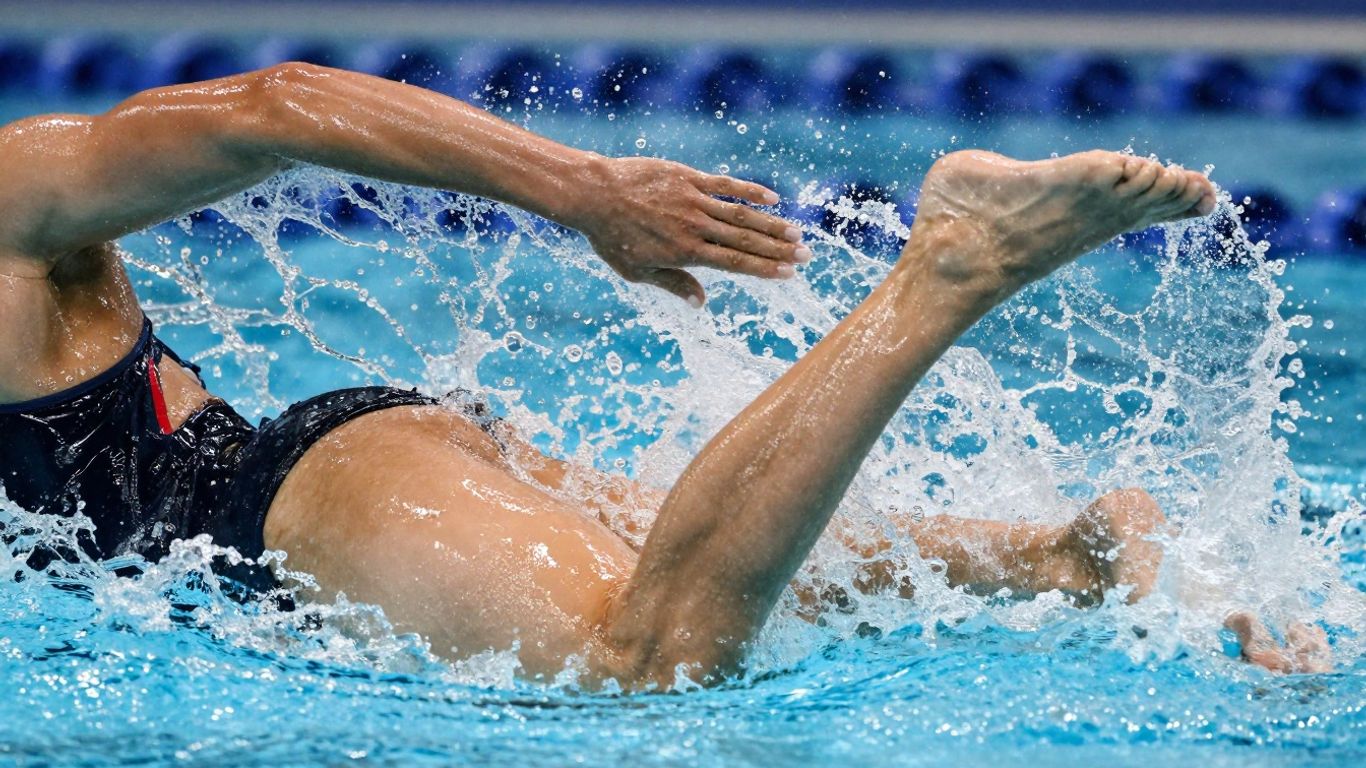
The flutter kick, often seen as the backbone of freestyle and backstroke, is more than just waggling your legs. It’s a coordinated movement that, when done right, really helps you glide through the water. The whole idea is to drive the kick from your hips, not just your knees, keeping your legs mostly straight and your toes pointed. Think of it like a whip – it starts from the base and gets faster towards the end. This hip-driven motion means your whole leg is involved, creating a more powerful and streamlined push. Your feet should stay mostly underwater; breaking the surface creates drag and wastes energy. It’s an alternating action, one leg going down while the other comes up.
Here’s a quick rundown of what makes a good flutter kick:
- Hip Drive: The power comes from your hips, not your knees. This keeps your legs straighter.
- Leg Position: Keep your legs relatively straight. A little bend is natural, but avoid bending your knees too much.
- Footwork: Point your toes. This makes your feet like little paddles, pushing water effectively.
- Kick Size: Small, quick kicks are better than big, slow ones. They create less drag.
- Underwater Flow: Keep your feet submerged. Splashing means you’re losing momentum.
Common Flutter Kick Mistakes To Avoid
Lots of swimmers, even those who’ve been at it for a while, fall into some bad habits with their flutter kick. It’s easy to start kicking from the knees, which is less efficient and creates more drag. Another common issue is bending the knees too much on the downbeat, or not keeping the feet pointed. Some people also make their kicks too wide or too splashy, which just slows them down. You might also find yourself not using your glutes and hamstrings enough on the upbeat, which means you’re not setting up the next downbeat properly.
Kicking from the knees is a big one. It’s like trying to push a boat with just your ankles – not much power there. You want that whip-like action starting from the hip, not a floppy knee.
The Two-Phase Kick System: Downbeat And Upbeat
Your flutter kick actually has two main parts: the downbeat and the upbeat. The downbeat is when your leg moves downwards, from near the surface to deeper. This is where most of your propulsion comes from, powered by your quads and hip flexors. Then there’s the upbeat, where your leg comes back up. This phase is mainly about getting ready for the next downbeat, powered by your hamstrings and glutes. While the downbeat does most of the heavy lifting for speed, the upbeat is super important for setting up that next powerful downstroke. They work in opposition – when one leg is kicking down, the other is kicking up. Getting the timing and the whip action right in both phases makes a huge difference.
Essential Drills To Master Your Kick
Alright, so you’ve got the theory down about how your legs should be moving, but how do you actually get them doing what they’re supposed to? Practice, mate. And not just any old splashing around, but targeted drills that really make you focus on what your legs are doing. These aren’t just for beginners, either; even seasoned swimmers can sharpen up their kick with a few focused sessions.
Vertical Kicking For Power And Stability
This one feels a bit like treading water, but with a purpose. Get into the deep end where you can’t touch the bottom. Cross your arms over your chest or put them straight up overhead. Now, just kick. The goal here is to keep your body upright and stable using only your flutter kick. It’s a ripper for building strength in those leg muscles and getting your core to work harder to keep you from sinking. Try to keep your head up and your body as streamlined as possible. You’ll be surprised how quickly your legs start to burn!
- Focus: Maintaining a stable, upright position.
- Benefit: Builds leg strength and core stability.
- Progression: Try holding a small weight (like a water bottle) just above the water to increase the challenge.
This drill forces you to use your kick for more than just propulsion; it’s about balance and control in the water.
Side Kicking For Rotation And Rhythm
This drill is all about getting a feel for how your kick works with your body’s rotation. Lie on your side, with your bottom arm extended out in front and your top arm resting by your side. Now, just kick. Focus on a smooth, consistent kick that helps you roll slightly from your hips. It’s a great way to feel how your kick can help drive your body through the water and improve your overall rhythm. Do a length on one side, then flip over and do a length on the other.
- Technique: Bottom arm extended, top arm relaxed. Kick on your side.
- Goal: Develop a smooth kick that aids body rotation.
- Practice: Alternate sides every 25 metres to build balanced technique.
Wall Kick Variations For Focused Practice
This is your chance to really isolate your kick without worrying about breathing or arm strokes. Hold onto the wall or the gutter, get into a streamlined position, and just kick. You can play around with different things here. Try kicking faster, slower, kicking with your knees bent more, or keeping them straighter. You can also try kicking with your body flat or slightly on your side. Because you’re not moving forward, you can really concentrate on the feel of the water against your feet and the movement coming from your hips.
- Setup: Hold the wall, streamline position.
- Variations: Experiment with tempo, ankle flexibility, and kick amplitude.
- Advantage: Uninterrupted focus on leg mechanics.
Snorkel Kicking For Uninterrupted Technique
Using a front-mounted snorkel is a game-changer for kick practice. Why? Because you can breathe whenever you want without turning your head! This means you can keep your head in a nice, stable position and focus 100% on your kick. Start with kick-only sets, just like you would with a kickboard, but without the board. Then, you can progress to doing single-arm drills while kicking, or even full stroke with a snorkel, really paying attention to how your kick is supporting your stroke. It’s the closest you’ll get to swimming with perfect technique without any breathing interruptions.
- Equipment: Front-mounted swimming snorkel.
- Benefit: Allows continuous focus on kick technique without breathing concerns.
- Progression: Start with kick sets, move to single-arm drills, then full stroke.
Incorporating Kick Practice Into Your Training
Alright, so you’ve been working on your kick technique, which is brilliant. But how do you actually make it a regular part of your swimming routine without it feeling like a chore? It’s all about smart integration, not just adding more laps. Think of it like adding a bit of spice to your usual meals – makes things more interesting and, well, better!
Warm-Up and Dedicated Kick Sets
Starting your swim session with a bit of kick-focused work is a no-brainer. It gets those leg muscles firing and reminds your body what a good kick feels like before you even think about your arms. You could do a few lengths just kicking, maybe with a board, focusing on that smooth, consistent motion. Then, later in the session, throw in a dedicated kick set. This isn’t just random kicking; it’s structured. Maybe it’s 4 x 100 metres, alternating between fast kicking and slow, controlled kicking. This builds both power and endurance.
Drill Integration With Your Regular Swims
This is where the magic happens. Instead of just swimming freestyle laps, mix it up. Try swimming a length of freestyle, then immediately follow it with a length of kick only, keeping the same rhythm. Or, do a lap with your arms doing their thing, and the next lap, focus solely on your kick, maybe holding a pull buoy to isolate it. This constant switching keeps your brain engaged and reinforces the kick’s role in the overall stroke. It’s about making the kick a constant companion, not an afterthought.
Varying Intensity For Strength And Technique
Your kick isn’t always going to be at race pace, right? So, your training shouldn’t be either. Mix it up! Some sets should be about pure power – short, sharp bursts of kicking as fast as you can. Think 25s or 50s where you really push it. Then, you need sets that focus on technique. This means slowing down, really feeling the water, and making sure every part of your kick is working efficiently. It’s like the difference between sprinting and a long, steady jog – both have their place.
The key here is consistency and variety. Don’t just do the same kick drills every time. Mix up the distances, the intensity, and the focus. Sometimes it’s about power, sometimes it’s about rhythm, and sometimes it’s just about feeling the water correctly. This keeps your body guessing and prevents you from hitting a plateau.
Here’s a quick idea for a kick-focused set:
- Warm-up: 200m easy swim, then 4 x 50m kick with board, focusing on steady rhythm.
- Main Set:
- 4 x 100m freestyle, with the first 50m of each 100m being kick-only, focusing on hip drive.
- 8 x 25m fast kick, with 30 seconds rest between each, aiming for maximum power.
- 2 x 200m kick with pull buoy, focusing on ankle flexibility and a relaxed, continuous kick.
- Cool-down: 100m easy swim.
Dryland Training For A Powerful Kick
You might think swimming is all about being in the water, but what you do on dry land can make a massive difference to your kick. Building strength and flexibility off the clock means you’ll have a more powerful and efficient kick when you’re actually swimming laps. It’s not just about doing more laps; it’s about making those laps count with a kick that really drives you forward.
Flexibility And Mobility Exercises
Having flexible ankles and hips is pretty important for a good flutter kick. If your ankles are stiff, you’re not going to push much water. We want those feet to be like little flippers, right?
- Ankle Sit: Kneel down and sit back on your heels, tops of your feet flat on the floor. Start with just a few seconds if it feels intense, and gradually build up to holding it for a minute. This really opens up the front of your ankle. Do this a few times.
- Dynamic Leg Swings: Stand tall and swing one leg forward and backward, then side to side. Keep it controlled, not wild. Do about 10-15 swings on each leg for each direction.
- Hip Circles: Stand with your feet shoulder-width apart and make big circles with your hips, first one way, then the other. This gets things moving in the hip joint.
Proper flexibility means your ankles can point more naturally, and your hips can move through a greater range of motion. This translates directly to a more effective water push and less strain on your joints.
Strength Development For Kick Power
Okay, so flexibility is one thing, but you also need some grunt in those legs. Think about the muscles that do the work: quads, hamstrings, glutes, and even your calves.
Here’s a quick rundown of some exercises:
- Squats: Classic for a reason. Bodyweight squats are a good start, but you can add weight like a kettlebell held at your chest (goblet squat) for more challenge. Aim for 3 sets of 10-12 reps.
- Lunges: Forward, backward, or side lunges all work your legs differently. Keep your torso upright and make sure your knee doesn’t go way past your toes. Try 3 sets of 10 reps per leg.
- Glute Bridges: Lie on your back with knees bent, feet flat on the floor. Lift your hips up, squeezing your glutes at the top. This is great for activating those powerful butt muscles. Do 3 sets of 15 reps.
Ankle And Foot Conditioning
Don’t forget the little guys – your ankles and feet! They’re the ones making contact with the water.
- Ankle ABCs: Sit on the floor with your legs straight out. Using your foot, ‘write’ the alphabet in the air. This works all those small ankle muscles. Do this a couple of times.
- Calf Raises: Stand with your feet flat and lift up onto the balls of your feet, then slowly lower. You can do this on a step to get a deeper stretch at the bottom. Aim for 3 sets of 15-20 reps.
- Toe Curls: Sit on a chair and place a small towel on the floor in front of you. Use your toes to scrunch up the towel. This strengthens the muscles on the bottom of your foot.
Leveraging Equipment For Kick Improvement
Alright, let’s chat about how some gear can really give your kick a boost. It’s not just about brute strength; it’s about using the right tools to get your legs working smarter and stronger in the water.
Using Kickboards Effectively
The humble kickboard is a classic for a reason. It lets you focus purely on your legs, taking the arms out of the equation. The trick is not to grip it too hard. If you’re white-knuckling the edges, your shoulders will tense up, and that can mess with your body position. Try holding it lightly at the front. This encourages a more streamlined position and helps you feel what your kick is actually doing without your upper body taking over. It’s brilliant for building leg endurance and getting a feel for that consistent flutter.
The Role Of Fins In Technique And Power
Fins are like magic for your feet. They make your feet bigger in the water, so you get more propulsion from each kick. This is fantastic for a couple of reasons. Firstly, it lets you feel what a good, powerful kick is like. You can swim faster and feel the water moving past your legs, which helps you understand the mechanics better. Secondly, they build strength. Swimming with fins, especially for longer sets, really works your leg muscles. Start with shorter fins if you’re focusing on technique, and then maybe move to longer ones when you want to build more power.
Pull Buoys For Kick Awareness
Now, this might sound a bit odd, but using a pull buoy can actually help your kick. When you put a pull buoy between your legs, it stops your legs from kicking. So, you’re just using your arms to propel yourself. This is great for understanding how much your kick normally helps you. You’ll notice you slow down a fair bit, and it really highlights the contribution your legs make to your overall speed. It’s a bit of a ‘negative training’ approach – you feel the absence of your kick, which makes you appreciate its presence and work harder to integrate it properly when you’re not using the buoy.
Advanced Kick Techniques And Cross-Training
Backstroke Kick Carryover Benefits
Ever thought about how your backstroke kick might actually help your freestyle? It’s a bit of a hidden gem. When you’re on your back, you can actually see your feet, which makes it way easier to spot if you’re doing something weird with your ankles or if your kick is too big. Plus, it works those same leg muscles, just from a different angle. This can lead to a more balanced leg development, which is always a good thing. Think of it as cross-training for your legs, giving them a bit of a different workout without you even realising it.
Butterfly Kick For Core Strength
The butterfly kick, that powerful dolphin motion, is a beast for building core strength. While it’s not the same as your flutter kick, the sheer power and control needed for butterfly translate really well. It forces your core to stabilise your body, and that’s a skill that definitely helps keep your whole body aligned and strong when you’re doing freestyle. It also really works on that ankle flexibility and explosive power, which can give your regular kick a bit of an extra punch.
Innovative Asymmetrical Kicking Patterns
Let’s get a bit creative with your kicking. Sometimes, doing the same thing over and over can lead to plateaus. Trying asymmetrical kicking patterns can shake things up. This means focusing a bit more on one leg while keeping the other one doing its job, or even switching up the rhythm within a single length. For example, you could try a six-beat kick for a bit, then transition to a two-beat kick. It sounds odd, but it can help build strength and coordination in ways you might not expect. It’s all about challenging your body to adapt and find new ways to be efficient.
Don’t be afraid to experiment with your kick. Sometimes the most unexpected drills can lead to the biggest breakthroughs. Think about how you can challenge your legs and core in new ways, even if it feels a bit strange at first. The goal is to build a more robust and adaptable kick that can handle different situations in the pool.
Get Your Kick On!
So, there you have it. We’ve gone through how to get your flutter kick sorted, from making sure your legs are doing the right thing to actually using it to move you through the water. Remember, it’s not just about kicking hard, it’s about kicking smart. Practice those drills we talked about, pay attention to how your feet feel in the water, and don’t be afraid to slow down to get it right. A good kick makes everything else in your swim so much easier, so stick with it. You’ll be gliding through the water before you know it.
Frequently Asked Questions
What’s the main difference between the downbeat and upbeat of a flutter kick?
The downbeat is the powerful part where your leg pushes water downwards, starting from your hip. The upbeat is the recovery phase where your leg comes back up, keeping it straight and relaxed, ready for the next downbeat. Think of the downbeat as the ‘push’ and the upbeat as the ‘prep’.
Why is it important to keep my legs mostly straight when kicking?
Keeping your legs mostly straight, with just a slight bend at the knee, helps create a more streamlined shape in the water. This means less drag and more efficient forward movement. Bending your knees too much is like riding a bicycle underwater – it creates drag and wastes energy.
How can I make sure my kick comes from my hips and not my knees?
Imagine your leg is a whip, starting the movement from your hip. Drills like vertical kicking can help you feel this hip-driven motion. If you focus on initiating the kick from your hips, your knees will naturally follow with a slight bend, rather than being the main source of the movement.
What’s the best way to practice my kick without getting tired quickly?
Using equipment like a kickboard can help you focus on your legs while giving your arms a break. Also, try doing dedicated ‘kick sets’ during your training, where you swim lengths using just your kick. Varying the intensity and distance of these sets will build strength and endurance over time.
How does kicking on my side help my swimming?
Kicking on your side helps you get used to the body position you use when breathing in freestyle. It builds a balanced and symmetrical kick, and helps you develop a good rhythm that matches your body’s rotation. It’s a great way to improve your overall freestyle technique.
Can dryland exercises really improve my swimming kick?
Absolutely! Exercises that improve flexibility in your ankles and hips, like ankle sits and leg swings, are super important. Strength exercises like squats also build power in your thighs and glutes, which are key for a strong kick. Conditioning your ankles and feet makes them more effective at pushing water.