Key Takeaways
DAS solar panels reviews are best read as a starting point rather than a substitute for checking the exact panel, installer and warranty offered in your quote.
- DAS Solar entered the Australian market relatively recently, so local support and long-term rooftop evidence deserve close attention.
- Panel efficiency is only one part of the decision; heat, shade, orientation and system design affect actual output.
- Check the exact model number, warranty terms, degradation schedule and certification before signing.
- Installation quality, roof condition and inverter compatibility can matter as much as the panel brand.
- A slightly higher upfront price may be worthwhile if it buys clearer support and stronger whole-system confidence.
Understanding DAS solar panels
DAS solar panels appeal to Australian buyers looking for a lower-cost option with modern cell technology. The sensible way to assess them is to separate documented specifications from broad marketing language and then consider how the complete system will operate on your roof. Local availability, installer experience and warranty handling also deserve as much attention as the module itself.
DAS Solar’s brand background and market position
DAS Solar was founded in China in 2018 and specialises in the research, development, manufacturing and marketing of N-Type high-performance photovoltaic cells, modules and system applications. Its activities also include the investment, construction and operation of power plants. For Australian buyers, the practical question is less about global scale and more about how established the local supply and support arrangements are.
One independent DAS Solar review describes the company as a relatively new participant in Australia, with a local office established in January 2024. That shorter local history means buyers have fewer Australian rooftop years to examine than they would with long-established suppliers. It does not automatically make a panel unsuitable, but it does make documentation and installer accountability particularly important.
Panel technologies and product ranges
The company’s published focus is on N-Type cells, modules and related photovoltaic system applications. Search results and installer discussions also refer to specific DAS models, including the WH120P, but a quote should always identify the precise model rather than relying on a family name or a description such as “Level 1”. Different models can have different electrical ratings, dimensions and warranty conditions.
Some industry material discusses DAS research partnerships and emerging cell architectures. Those developments may be relevant to the company’s direction, but they should not be treated as proof that every panel currently offered to an Australian household uses the newest technology. The panel data sheet and certificate for the quoted model are the documents that matter at purchase time.
What specifications matter most
A useful comparison starts with the module’s rated power, efficiency, dimensions, temperature coefficient, maximum system voltage and current. Warranty length matters too, although its wording and claim process are more revealing than the headline number. The exact model number matters because a broad product range can contain meaningful differences.
For a quick first pass, organise the quote around the following information:
| Specification | Why it matters | What to check |
|---|---|---|
| Rated power | Helps determine how many panels fit the target system size | Watts per panel and total array capacity |
| Efficiency | Indicates how much electricity the panel produces from a given roof area | Test conditions and exact model |
| Temperature coefficient | Helps explain output changes on hot days | Lower temperature-related losses are generally preferable |
| Product warranty | Covers defined manufacturing or material issues | Length, exclusions and claim pathway |
| Performance warranty | Sets a promised minimum output over time | Degradation schedule and end-point percentage |
The figures should then be checked against the inverter’s operating voltage and current range. A panel that looks attractive on paper may be a poor match if the electrical design is not suited to the inverter or roof layout.
Availability for Australian households
Availability can vary by state, distributor and installer. A panel appearing in a quote does not necessarily mean the installer has deep experience with it, or that replacement stock will be easy to source several years later. Ask who imports the module, who provides the Australian warranty contact and whether the installer will remain involved if a claim is needed.
The Clean Energy Council approval status of the exact module is another practical check for systems seeking access to Australian incentives. Buyers should also confirm that the proposed installer is accredited and that the paperwork will identify the installed model correctly. This is a good place to compare the roof work itself with a general roofing homeowner guide, particularly where an older roof may need repairs before panels are mounted.
Assessing DAS solar panel performance
Panel performance is often presented as a single efficiency percentage, but household output is shaped by much more than that laboratory figure. Roof direction, tilt, temperature, cloud, shading, soiling and inverter behaviour all influence the electricity reaching the home. That is why DAS solar panels reviews should distinguish rated performance from evidence gathered on Australian roofs.
Efficiency ratings and real-world energy output
Efficiency describes the proportion of sunlight converted into electricity under standard test conditions. It helps when roof space is limited, but it does not predict a fixed amount of annual energy for every home. Two systems with the same panel rating can produce different results if one has morning shade, a less favourable roof angle or poorer ventilation beneath the modules.
The better comparison is the estimated annual generation for the actual address, together with the assumptions behind it. Request the system design, shading assumptions and expected output rather than comparing wattage alone. A reputable installer should be able to explain why the proposed array size suits the household’s usage and roof area.
Performance in Australia’s heat and sunlight
Australian rooftops can experience high module temperatures, and solar panels generally produce less power as cell temperature rises above their test reference point. The temperature coefficient in the data sheet provides a way to compare this effect, although it is only one part of the thermal picture. Roof ventilation, mounting clearance and local climate also influence operating conditions.
A coastal home, an inland property and a tropical Queensland roof do not present identical conditions. Salt exposure, dust, intense sun and severe weather may all affect maintenance and long-term operation. Treat regional suitability as a system-design question rather than assuming a panel will perform identically everywhere in Australia.
Low-light and shaded-condition behaviour
Cloudy weather does not stop a solar system producing electricity, but output falls as available light falls. Shade is more complicated because a chimney, tree or neighbouring building can affect one or several modules at different times of day. The inverter architecture and the way panels are electrically grouped can therefore be important for a roof with uneven shading.
Microinverters or separate optimisers may help a designer manage some roof layouts, but they do not remove the need for a proper shade assessment. Ask for an explanation of the expected morning, midday and afternoon behaviour. If a quote uses a panel with a particular inverter, confirm that the electrical ratings are compatible rather than relying on a generic claim about shaded performance.
Comparing laboratory claims with independent evidence
Laboratory ratings are useful because they create a common testing reference, but independent Australian evidence adds context. For a newer local entrant, the available evidence may be thinner than the marketing material, so a cautious buyer should avoid treating a claimed efficiency figure as a guaranteed household outcome.
The most useful questions concern the exact model, the age of the installation data and whether the results come from comparable Australian conditions. A quote supported by clear documents and a realistic production estimate is more valuable than an impressive but unqualified headline number.
Examining build quality and durability
A solar panel is exposed to sun, wind, rain and temperature changes for decades. Durability therefore depends on the cell design, glass, frame, seals, junction box and the quality of installation. It also depends on whether the roof and mounting system were properly assessed before the array was fitted.
Cell design, glass and frame construction
The data sheet should identify the cell format, module construction, dimensions, weight and electrical characteristics. It should also identify the glass and frame details where those are relevant to the installation. Buyers should be wary of comparing a product family label with another brand’s fully specified model; like-for-like comparison requires the technical documents.
The installer should explain how the panel will be clamped, where rails will sit and whether the roof structure can carry the additional load. A neat-looking array is not enough if cable management, drainage or access for future maintenance has been overlooked.
Resistance to wind, hail and harsh weather
Wind and hail ratings are meaningful only when the mounting system, clamp positions and roof structure are also suitable. Australian homes in cyclone-prone or exposed regions may need design choices that differ from those used in sheltered metropolitan suburbs. Coastal locations can add salt and corrosion considerations.
Ask for the relevant certifications and the installer’s proposed method for the site, rather than accepting a general statement that a panel is weather resistant. The broader lesson also applies to other home improvements: a useful home construction cost guide can help frame why the supporting structure and labour should not disappear inside a cheap headline quote.
Degradation rates over the panel’s lifetime
Solar modules gradually lose output, and the performance warranty sets out the manufacturer’s stated minimum over time. The figure at year 25 is not the same as a promise that every panel will deliver that output in every condition. Read whether the degradation is described as an initial step followed by an annual rate, and check what evidence is needed for a claim.
A lower degradation rate can improve lifetime value, but only if the warranty is enforceable and the installation remains sound. Keep the original invoice, model information, serial numbers and commissioning records so the system’s history is not difficult to reconstruct later.
Installation factors that affect reliability
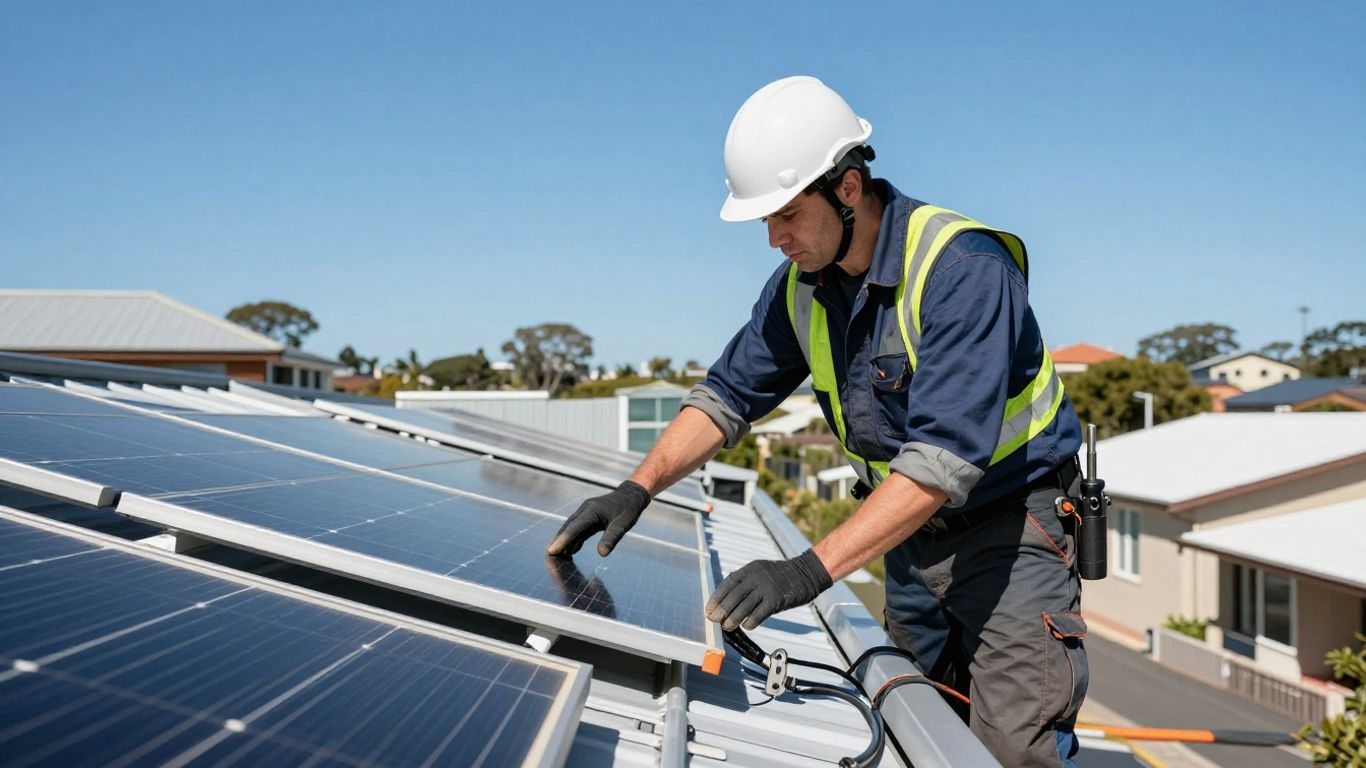
Many failures associated with rooftop solar are linked to system design, handling or installation rather than the advertised panel specification. Poorly positioned clamps, damaged cables, inadequate roof penetrations and water ingress can all create trouble. The installer’s workmanship warranty and track record should sit beside the module warranty in your comparison.
Before accepting a quote, ask who will perform the electrical work, who is responsible for roof penetrations and how faults will be diagnosed. Photos of the finished cable routes and mounting points can be useful records, especially if the installer or property owner changes later.
Reviewing warranties and after-sales support
Warranty language can make a solar quote look reassuring while leaving important practical questions unanswered. There is usually a product warranty for manufacturing or material defects and a performance warranty for retained output. The value of either depends on the named warrantor, the claim process and the ability to obtain help in Australia.
Product and performance warranty coverage
The exact coverage varies by model and document version. One discussion of the WH120P reports a 12-year product warranty and a performance warranty specifying 85.5% after 25 years. Those figures should be verified against the current written warranty supplied with the quote, because an older discussion or a distributor summary may not apply to the model being offered.
Do not compare warranty years without reading the conditions. Check whether labour, removal, transport and reinstallation are covered, and whether the warranty is transferable if the home is sold. A long performance period may still be difficult to use if testing requirements are costly or unclear.
Warranty exclusions and claim requirements
Common claim requirements can include proof of purchase, installation records, serial numbers, photographs and evidence that the panel was installed and maintained correctly. The warranty may also exclude damage caused by improper handling, unauthorised modification, unusual external events or incompatible equipment. These details are not small print to ignore; they define the practical protection being purchased.
Request the complete warranty PDF before paying a deposit. Save it with the invoice and system documentation, and ask the installer to explain which party handles the first inspection if output falls or a module develops a visible fault.
Who handles support in Australia
A local contact can make a warranty issue easier to progress, but the existence of an Australian office is not the same as a guarantee of fast resolution. Ask whether the retailer, distributor, installer or manufacturer logs the claim and who pays for diagnosis. It is also worth asking whether replacement modules are expected to remain electrically and physically compatible with the original array.
This is where the installer’s business practices matter. A company that explains its service process clearly is easier to assess than one that simply repeats the manufacturer’s warranty headline. Buyers can also review the Sure Send dashboard as an example of why clear task ownership and follow-up systems matter in service businesses, although it is not a solar product.
How DAS compares with established competitors
A comparison should be made between exact models, not between brand reputations. Look at efficiency, temperature coefficient, degradation wording, product support, installer confidence and total system price. Where local evidence is limited, established alternatives may offer buyers more publicly visible Australian history, while a newer option may still be reasonable if the documentation, installer and price are convincing.
The DAS Solar company description identifies its work across N-Type photovoltaic cells, modules, system applications and power-plant activities. That is useful background, but it does not by itself establish the expected result of a particular residential installation. Keep the comparison grounded in the panel and contract actually being offered.
Calculating value for money
The cheapest panel quote is not necessarily the cheapest solar system over its useful life. Total value depends on the installed price, expected generation, electricity use, export arrangements, maintenance, warranty confidence and the possibility of adding a battery later. A simple calculation is more useful than a brand label alone.
Upfront system costs and installation charges
Request an itemised quote showing panels, inverter, mounting, switchboard work, meters, labour, monitoring and any roof repairs. Two quotes can appear to offer the same system size while including different electrical upgrades or different levels of after-sales service. Check whether the price assumes a straightforward roof or includes allowances for difficult access and additional cable runs.
For readers comparing broader household projects, renovation cost guides offer a useful reminder that labour and site conditions can materially change a headline estimate. Solar should be assessed in the same practical way: ask what is included, what is excluded and what could become a variation.
Expected savings and payback periods
Payback depends on how much electricity the household uses during solar-producing hours, the retail electricity rate, feed-in tariff, system output and any finance costs. A home that consumes more of its solar power directly may achieve a different result from a mostly empty home during the day. Battery storage changes the calculation again.
Treat the installer’s estimate as a scenario, not a promise. Ask to see conservative and optimistic cases, and consider future electricity prices separately from the panel’s technical performance. A shorter payback is attractive, but reliability and support can matter over the decades that follow it.
Balance-of-system components to budget for
Panels are only one part of a working solar array. The inverter, mounting rails, cabling, protection equipment, monitoring and any switchboard changes all influence cost and performance. If a battery is a future possibility, ask whether the proposed inverter and wiring approach leaves a practical path for expansion.
An itemised comparison can expose a low quote that omits necessary work. It also makes it easier to compare a panel-only price with a genuinely equivalent installed system, rather than judging the module in isolation.
When a cheaper panel may cost more over time
A lower initial price can lose its advantage if the system produces less than expected, requires difficult warranty administration or needs early replacement. That does not mean paying more always produces a better result. It means the buyer should price uncertainty, service access and installation quality alongside the panel’s rated output.
A sensible decision may be the quote that offers the clearest documents and the strongest local accountability, even if its panel is not the cheapest line item. The right answer depends on the roof, household usage and the terms written into the contract.
Comparing DAS panels with alternatives
Comparing panels is useful when it is tied to the home’s constraints. Premium branding, budget pricing and newer technology each bring trade-offs, while inverter selection can change how the array behaves on a complex roof. Australian buyers should compare complete proposals rather than choosing from a list of panel names.
How DAS compares with premium solar brands
Premium products may appeal through longer market histories, broader installer familiarity or more extensive local service networks. Those advantages can reduce uncertainty, but they do not make every premium panel the right choice for every roof. Compare the exact data sheets, warranty terms and installed prices before paying for a reputation.
The Australian market includes many different panel categories, and a current solar brand comparison can help buyers see how efficiency, warranties and regional suitability are commonly assessed. Use such comparisons as a shortlist, then return to the documents attached to your own quote.
How DAS compares with budget-focused options
Budget-focused panels can be sensible where roof space is plentiful and the price difference is meaningful. The risk is that a low price can conceal thinner support arrangements, less installer familiarity or less favourable warranty administration. The panel should be judged as part of the contractor’s full offer, not as a standalone product.
Ask what the cheaper option changes: is it the module, the inverter, the mounting system, the workmanship warranty or the projected output? A transparent explanation is more useful than a simple claim that one panel is “better”.
Matching panels to inverters and battery systems
The inverter must operate within the panel array’s voltage and current limits, while the number of panels and their electrical grouping should suit the roof layout. Shade, multiple roof orientations and future battery plans may influence whether a string inverter, microinverter or another arrangement is appropriate. These are design decisions for an accredited installer, not just shopping preferences.
Ask for the proposed electrical design and check that the model numbers in the quote match the equipment delivered. Compatibility should also be confirmed if a battery is likely later, since not every future addition will be simple or economical.
Key questions to ask an Australian installer
A good installer should welcome specific questions and answer them with documents rather than pressure. Before signing, ask about the exact panel model, expected annual generation, shade assumptions, warranties and service process. Also ask who will be responsible if a fault involves both the panel and the inverter.
These questions help turn a broad online search into a decision based on your property:
- Is the exact module approved and available through an identifiable Australian distributor?
- What annual output is expected at this address, and what assumptions produced that estimate?
- Which workmanship, product and performance warranties apply, and who handles claims?
- How will shade, roof condition, wind exposure and future battery plans affect the design?
The answers should be written into the quote or contract wherever possible. Readers who are also assessing an online presence for a trades business may find the Squarespace suitability guide a separate but useful reminder that clear local information and easy contact paths influence trust.
Conclusion
DAS solar panels reviews point to a choice that needs careful, model-specific checking rather than a quick yes-or-no verdict. Verify the data sheet, warranty, local support, installer credentials and whole-system design, then compare the expected output and total cost with alternatives. For an Australian household, confidence comes from clear evidence and accountable installation as much as from the panel’s headline specifications.
Frequently Asked Questions
Are solar panels worth buying in Australia?
They can be worthwhile when the system is correctly sized for the home, the household uses a reasonable share of its generation and the quote is assessed against total installed cost. Results vary with location, roof conditions, electricity prices and usage patterns.
What is the most important solar panel specification?
There is no single best specification. Rated power, efficiency, temperature coefficient, degradation terms, warranty coverage and compatibility with the inverter should be considered together.
Does shade make rooftop solar unsuitable?
Not necessarily. A detailed shade assessment and suitable system design can reduce the effect, but heavily shaded roofs may produce less energy and require a different electrical arrangement.
How long do solar panels usually last?
Solar panels are designed for long service, with performance warranties commonly extending for decades. Actual life depends on product quality, weather exposure, installation workmanship and maintenance.
Should I choose a panel with the longest warranty?
A longer warranty can be useful, but its exclusions, claim process and coverage of labour or replacement costs matter just as much as the number of years printed on the page.
Do solar panels work during cloudy weather?
They continue to generate electricity in diffuse light, although production is lower than on a clear day. The reduction depends on cloud thickness, system orientation and local conditions.
What should an Australian solar quote include?
A quote should identify the panel and inverter models, system size, expected generation, installation work, warranties, monitoring, exclusions, payment terms and any switchboard or roof-related costs.