

Key Takeaways
A 100 ah lithium battery can be a practical centrepiece for camping, caravans and small off-grid systems, but the label alone does not tell you how long it will run your equipment.
- Convert amp-hours into watt-hours before comparing batteries or estimating runtime.
- LiFePO4 is commonly chosen for deep-cycle use because it is efficient, light and suited to repeated cycling.
- Check voltage, charging equipment, battery management, dimensions and installation requirements together.
- Match the battery to the loads you actually use, including fridges, inverters, lights and communications gear.
- Good storage, temperature control and regular inspections help protect performance and service life.
Understand what a 100 ah lithium battery can power
A 100 ah lithium battery sounds substantial, and it can provide useful energy for a weekend setup or a modest off-grid system. Its practical output depends on voltage, usable depth of discharge, appliance demand and conversion losses. A fridge that cycles on and off is very different from a kettle or induction cooktop that draws heavily for a short period. Start with the energy calculation, then consider how the battery will be charged each day.
Converting amp-hours into usable watt-hours
Amp-hours describe electrical charge, while watt-hours describe energy. To make a useful comparison, multiply the battery’s nominal voltage by its capacity: a 12.8-volt, 100 ah battery has roughly 1,280 nominal watt-hours. The amount available to your appliances will be lower after allowing for the recommended depth of discharge, inverter losses and other system inefficiencies.
For a simple planning estimate, you might work with 1,000 usable watt-hours rather than the full nominal figure. That is not a universal specification; it is a cautious budgeting assumption that leaves room for system losses and battery protection limits. Check the manufacturer’s stated usable capacity when making a final decision.
Estimating runtime for common appliances
Runtime is found by dividing usable watt-hours by the appliance’s average wattage. A 40-watt load could theoretically run for about 25 hours from 1,000 usable watt-hours, while a 400-watt load might run for around 2.5 hours. Real results vary because compressors cycle, thermostats switch loads on and off, and some appliances have a high starting surge.
Make a small load list before shopping. Include the operating hours for each device rather than adding every appliance’s maximum rating together. A fridge, LED lights, phone chargers and a small laptop may be comfortable for a 100 ah lithium battery, while a high-demand heater, electric hotplate or large coffee machine can consume the reserve quickly.
Comparing lithium capacity with lead-acid batteries
A lithium battery is often compared with a lead-acid battery of the same nominal capacity, but the comparison is not perfectly even. Lithium systems are generally designed to use a greater portion of their stored energy without the same voltage decline associated with deep lead-acid discharge. They also tend to weigh less and accept charge more readily, although the purchase price and charging requirements need to be considered.
The useful question is not simply whether both batteries say 100 ah. Ask how much energy each can safely deliver, how frequently it will be cycled and whether the vehicle or solar system can recharge it. A smaller, lighter battery with more usable energy may suit a caravan better than a larger nominal-capacity alternative.
Recognising the impact of inverter losses and temperature
An inverter changes battery power into household-style alternating current, but it does not do so without loss. Its idle consumption and conversion efficiency reduce the energy reaching a 240-volt appliance. High starting currents can also trip an inverter or battery protection system even when the average wattage appears acceptable.
Temperature matters as well. Cold conditions can reduce available performance, and many lithium batteries restrict charging at low temperatures to prevent damage. Hot storage areas may shorten service life. For remote Australian travel, place the battery away from direct heat and allow airflow around associated charging equipment. The advice in this outback travel guide is a useful reminder that power planning sits alongside water, navigation and vehicle preparation.
Choose the right battery chemistry and specifications
The battery chemistry is only one part of a suitable system. Voltage, usable capacity, charging profile, protection electronics and physical fit all affect whether a battery works in a caravan or off-grid installation. Read the technical sheet rather than relying on a product title. Two batteries with similar names can have quite different limits.
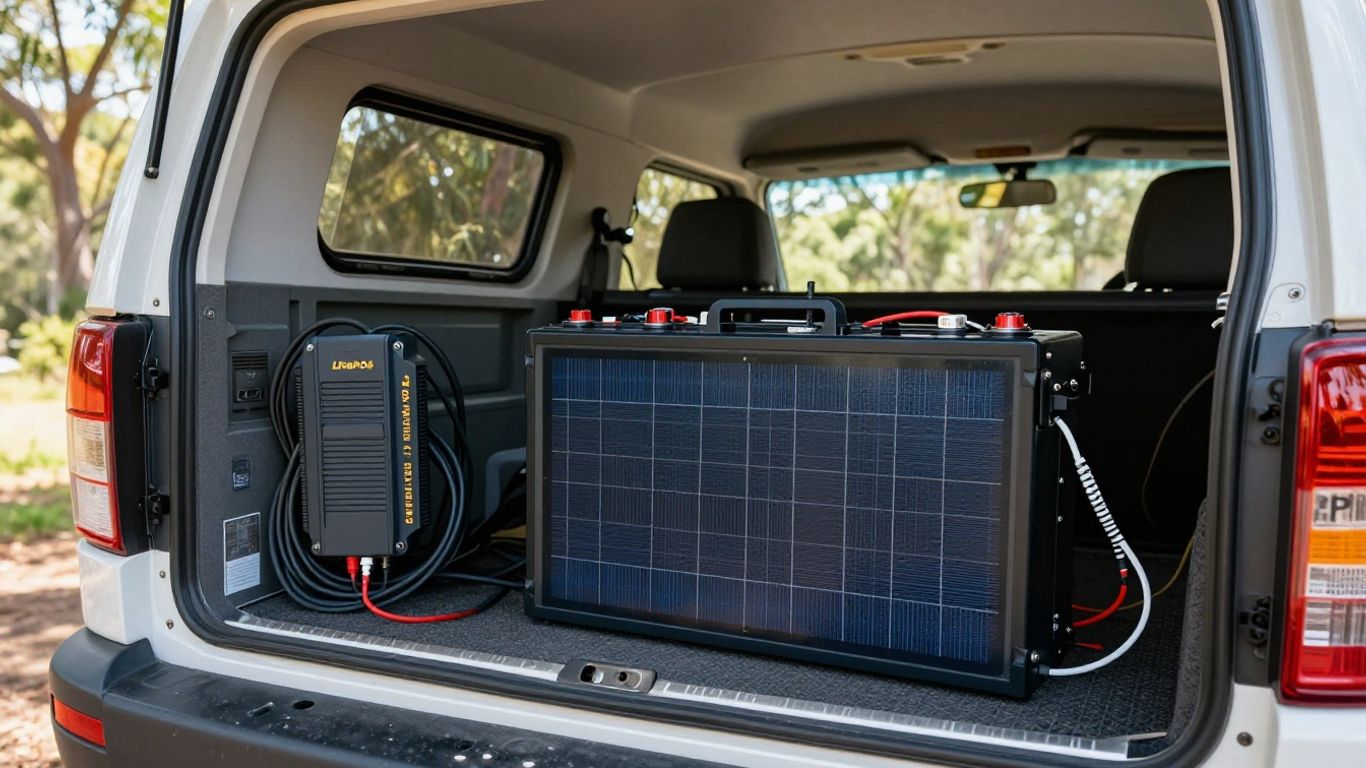
Why LiFePO4 is the common choice for deep-cycle use
Lithium iron phosphate, usually written as LiFePO4 or LFP, is widely used for repeated charge and discharge applications. It is valued for its stable voltage behaviour, relatively low weight and ability to deliver usable energy over many cycles. It is still a battery that needs correct charging, protection and installation; lithium does not remove the need for sound system design.
For a caravan or solar installation, look for a battery explicitly described as deep-cycle and confirm its charging requirements. The Battle Born 100Ah 12V LiFePO4 battery is described in its source as a lightweight, maintenance-free alternative to lead-acid, with fast recharge capabilities and advanced LiFePO4 safety features. Those are documented product claims, not a promise that every battery will perform identically in every installation.
Checking nominal voltage and system compatibility
Most small camping systems are built around 12 volts, but the actual nominal voltage of a lithium battery may be listed as 12.8 volts. That is normal for many four-cell LiFePO4 designs, yet the battery still needs to suit the vehicle, charger, inverter and solar controller. A 24-volt or 48-volt system requires a different arrangement or a battery designed for that voltage.
Check the charging voltage range, maximum continuous discharge current and inverter requirements before buying. Also confirm whether the existing charger has a lithium-compatible profile. A battery can physically fit a compartment and still be unsuitable if the charge source or connected loads exceed its limits.
Evaluating cycle life, depth of discharge and efficiency
Cycle life is normally quoted under particular test conditions, so it should be read alongside depth of discharge and operating temperature. A battery cycled gently may achieve a different result from one regularly discharged near its limit. Efficiency also matters because energy is lost during charging and delivery, especially when an inverter is part of the system.
Consider how often you will use the battery. A weekend camper may prioritise weight and ease of installation, while a daily off-grid system may place more value on cycle-life specifications and service support. The LiTime 12V 100Ah LiFePO4 battery is presented in its source as offering more than 4,000 deep cycles; treat that figure as a product specification to compare with the test conditions and warranty terms.
Understanding built-in battery management systems
A battery management system, or BMS, monitors cells and can protect against conditions such as overcharge, excessive discharge, over-current and temperature problems. Its limits are important because the BMS may disconnect the battery when a threshold is reached. That protective action is useful, but it can also interrupt an inverter or other load if the system is undersized.
Ask whether the BMS supports the continuous and peak current required by your equipment. Find out whether low-temperature charging protection is included and how the battery communicates its status, if at all. A BMS is a layer of protection, not a replacement for correctly sized cables, fuses and chargers.
Match the battery to your intended application
The right battery depends on the way you travel and the equipment you expect to run. A caravan may need dependable overnight power for refrigeration and lighting, while a boat may have short bursts from electronics or a trolling motor. A small solar installation has a different charging rhythm again. Map the use case before comparing features.
Selecting a battery for caravans and camper trailers
In a caravan or camper trailer, measure the battery compartment before choosing capacity. Record the length, width, height, terminal position and available cable route, then check the battery’s weight against the mounting structure. Consider whether the battery will be charged from solar, mains power, a vehicle alternator or a combination of sources.
A 100 ah lithium battery may suit a compact touring setup, particularly when the daily loads are moderate and the battery can be replenished during travel. If you spend several days in one place, solar collection and energy conservation become just as important as the battery size. The caravan travel planning advice also highlights the practical value of preparing for long distances, fuel stops and remote conditions.
Powering camping fridges, lights and portable devices
Camping fridges, LED lighting, phones, cameras and laptops are common moderate loads. A fridge’s average consumption depends on its insulation, ambient temperature, thermostat setting and how often it is opened. Phones and lights use little individually, but several days of repeated charging can add up when the battery has no reliable recharge source.
Keep high-wattage appliances separate in your calculations. A short burst from a kettle may use more energy than many hours of LED lighting. If you want homemade food on a trip, remember that a Vitamix blender is a mains-powered appliance discussed for making ice cream; equipment of that type should be checked carefully against the inverter’s continuous and surge ratings before being added to a camping load plan.
Supporting solar systems and off-grid setups
Solar panels do not replace battery capacity; they replenish it during suitable daylight conditions. Size the battery around overnight and poor-weather demand, then size the solar array and controller around the energy that must be restored. Shade, orientation, seasonal sunlight and cable losses all influence the result.
An off-grid system also needs a clear priority order. Refrigeration, communications and lighting may matter more than occasional convenience loads. Keep a record of daily consumption for the first few trips and adjust the system from real observations rather than the most optimistic estimate on a product page.
Using a battery for marine and 4WD accessories
Marine and four-wheel-drive installations face vibration, moisture, dust and awkward mounting spaces. Confirm that the case, terminals and mounting method suit the environment, and keep exposed connections protected from corrosion. Accessories such as sound systems, pumps, winches and electric motors can have very different starting or continuous current requirements.
The Dakota Lithium 12V 100Ah Deep Cycle Heated LiFePO4 Battery is described as having a rugged, waterproof case and a BMS that protects against overheating, overcharging and short circuits. Those features may be relevant to a demanding installation, but the vehicle’s cable size, fuse selection and charging system still need to be assessed separately.
Compare the features that affect buying decisions
Once capacity and chemistry are settled, smaller design details can determine whether a battery is convenient to live with. Monitoring, cold-weather behaviour, water resistance and physical dimensions are not equally important for every buyer. Prioritise the features that match your storage location and travel habits rather than paying for specifications you will never use.

Heated batteries for cold-weather charging
Lithium batteries generally need protection from charging at temperatures below their permitted range. Some models include a heating function or a low-temperature charging cut-off. A heated battery can be useful for alpine trips, winter storage or installations exposed to cold overnight conditions, but check whether the heating function draws energy from the battery and what charger is required.
Do not assume that a heated label means the battery can be charged in every freezing situation. Read the operating limits and confirm how the protection system behaves. For occasional mild winter camping, insulation and sensible placement may be enough; for regular cold-weather use, the temperature specification deserves closer attention.
Bluetooth monitoring and battery displays
Monitoring can show state of charge, voltage, current and fault information, depending on the battery and its app or display. It is useful when the battery is hidden inside a compartment, because you can spot unusual consumption or a charging problem without opening the installation. A monitor is most helpful when you know what readings mean and check them over time.
Bluetooth range, app compatibility and access to historical data vary. Consider whether you need a phone app, a shunt-based reading or a simple dashboard. Do not treat a percentage display as laboratory precision; it is an estimate based on the battery’s internal measurements and configuration.
Waterproof ratings and rugged construction
An ingress-protection rating gives a defined indication of resistance to dust and water under specified test conditions. It does not mean a battery can be submerged, installed carelessly or left with wet terminals. Enclosures, cable glands and mounting orientation all affect real-world protection.
For a boat, ute or exposed storage compartment, inspect the case, terminal covers and mounting points. A rugged enclosure is helpful, but it should be paired with a dry, secure location where water cannot pool around electrical connections. Cleaning and inspection remain part of ownership.
Terminals, mounting dimensions and weight
A battery that does not fit is not a bargain. Compare the published dimensions with the compartment, including space above terminals and room for cables to bend without strain. Weight affects lifting, vehicle payload and the security of the mounting bracket, especially in a camper trailer that travels over corrugated roads.
Use this quick comparison before ordering. It keeps the decision grounded in the installation rather than in headline capacity alone.
| Specification | Why it matters | What to check |
|---|---|---|
| Nominal voltage | Determines system compatibility | Battery, charger and inverter voltage |
| Usable capacity | Indicates practical runtime | Depth-of-discharge guidance |
| Continuous current | Supports normal appliance demand | Inverter and accessory draw |
| Dimensions and weight | Determines fit and mounting safety | Compartment and payload limits |
The table is a starting point, not a substitute for the full data sheet. Pay particular attention to terminal orientation and maximum cable size, as these details can turn an apparently suitable battery into a difficult installation.
Plan charging and installation safely
A lithium battery should be treated as one component in an electrical system. Charging sources, protective devices, wiring and mounting all need to work together. If you are replacing an existing lead-acid battery, do not assume every part of the old installation is automatically suitable. When the system is large, unfamiliar or permanently wired into a vehicle, have the work checked by a qualified installer.
Choosing compatible solar, mains and DC-DC chargers
Lithium batteries use a charging profile that differs from many traditional lead-acid batteries. Solar controllers, mains chargers and DC-DC chargers should have a suitable LiFePO4 setting or be specifically approved for the battery. Alternator charging may also require a DC-DC charger to control the charging process and protect the vehicle’s electrical system.
Check the charger output against the battery’s permitted charge current. More charging power is not always better if the battery or cabling cannot safely accept it. If several charging sources are connected, confirm how they interact rather than simply adding them together.
Sizing cables, fuses and isolation switches
Cable size should reflect current, cable length and acceptable voltage drop. An inverter can draw substantial current from a 12-volt battery, so short, correctly sized cables are particularly important. A fuse or circuit breaker should be placed close to the battery where it can protect the cable from a short circuit.
A practical installation usually includes a suitable isolation method so the battery can be disconnected during servicing or storage. Ask an installer to check the prospective fault current, fuse rating and cable termination. Undersized wiring can become hot even when the battery itself is working normally.
Connecting batteries in series or parallel
Parallel connections increase available amp-hours while keeping the system voltage similar; series connections increase voltage while keeping amp-hours broadly similar. Batteries connected together should be compatible in chemistry, voltage, capacity, age and condition. Follow the manufacturer’s rules, including any limits on the number of batteries and the use of communication cables.
Use balanced cable layouts and appropriate protection for each branch where required. Never connect batteries with significantly different states of charge without following the manufacturer’s procedure. A mistake in polarity can cause immediate damage, so check the positive and negative terminals with a meter before final connection.
Following ventilation, mounting and polarity requirements
LiFePO4 batteries generally have different ventilation considerations from batteries that release gas during normal charging, but the installation still needs to follow the product instructions and local requirements. Secure the battery against movement, protect terminals from accidental contact and keep it away from heat sources. Leave enough space to inspect connections and allow any approved monitoring equipment to function.
Before energising the system, verify polarity at every connection and confirm that the isolation switch is accessible. A useful installation checklist includes:
- Confirming the battery is firmly restrained for travel.
- Checking cable size, fuse placement and terminal tightness.
- Verifying charger settings for the battery chemistry.
- Testing polarity and measuring voltage before connecting sensitive equipment.
These checks take little time compared with repairing a damaged charger, inverter or battery. If the installation is not familiar, professional advice is the safer option.
Maintain and protect a 100 ah lithium battery
Lithium batteries usually need less routine attention than flooded lead-acid batteries, but they are not maintenance-free in the broad sense. Their health depends on suitable storage, sensible charging and protection from physical damage. A simple inspection before and after a trip can reveal loose terminals, unexpected discharge or a charger that is no longer behaving correctly.
Setting suitable storage charge levels
For storage, follow the battery maker’s recommended state of charge rather than leaving the battery completely full or completely flat for months. Disconnect unnecessary loads, switch off chargers when appropriate and store the battery in a dry area within its stated temperature range. Check the voltage or monitoring system periodically, particularly if the battery remains connected to alarms, trackers or other small draws.
A battery stored in a caravan can slowly discharge through connected equipment even when the main appliances are off. Isolating the battery or using a suitable maintenance approach helps prevent an extended low-voltage condition.
Avoiding overcharging, deep discharge and extreme temperatures
Use chargers with the correct lithium profile and do not bypass the BMS’s protective functions. Repeatedly draining a battery to its cut-off point can place more stress on the system than leaving a sensible reserve. Heat, freezing conditions and direct sun can also affect performance and service life.
If the battery disconnects unexpectedly, investigate the cause instead of repeatedly resetting the system. The issue may be an overloaded inverter, an unsuitable charger, a poor connection or a temperature limit. Correcting the cause is safer than treating the protection system as an inconvenience.
Inspecting connections and monitoring battery performance
Look for looseness, corrosion, damaged insulation, chafing and signs of water entry. Terminals should be clean and secure, with protective covers where the installation calls for them. Compare your monitoring readings with actual use: an unexplained drop in capacity, repeated cut-outs or unusual charging behaviour deserves attention.
Keep notes about charge sources, major loads and trip conditions. Over a few months, those observations can show whether the battery is being undersized or whether a particular appliance is consuming more energy than expected. This kind of record is more useful than relying on a single percentage reading.
Understanding warranties and end-of-life replacement
Read the warranty before installation, including its cycle assumptions, charging requirements, approved uses and exclusions. Some warranties depend on using compatible chargers or approved monitoring equipment. Keep the purchase record and installation details, particularly if the battery is fitted permanently in a vehicle.
When the battery reaches the end of its useful life, do not place it in household rubbish. Follow Australian local disposal or recycling guidance for lithium batteries, and protect the terminals during transport. Replacing the battery is also a good time to inspect the charger, cables, fuses and mounting hardware as a complete system.
Conclusion
Choosing a 100 ah lithium battery is less about finding the biggest number and more about matching usable energy, chemistry, charging equipment and physical fit to the way you camp or live off-grid. Estimate your real loads, allow for losses and temperature, then check the installation details before buying. A carefully matched battery should make power planning simpler, safer and more predictable.
Frequently Asked Questions
How much power does a 100 ah lithium battery provide?
A 12.8-volt, 100 ah battery has roughly 1,280 nominal watt-hours, although the usable amount depends on its discharge limits, efficiency, temperature and connected equipment.
How long will a 100 ah lithium battery run a fridge?
It depends on the fridge’s average daily consumption, ambient temperature, insulation, thermostat setting and other loads sharing the battery. Use the manufacturer’s energy figure and allow a practical reserve.
Is LiFePO4 suitable for caravan use?
LiFePO4 is commonly used in caravans because it offers useful energy at relatively low weight and supports repeated cycling. The battery must still be compatible with the caravan’s charger, wiring and inverter.
Can a 100 ah lithium battery run an inverter?
It can run an inverter if the battery’s continuous and peak current limits, cables, fuses and inverter rating are suitable. High-wattage appliances may reduce runtime quickly or trigger protection.
Can lithium batteries be charged in cold weather?
Charging limits vary by model. Some batteries include low-temperature charging protection or heating, while others require charging to stop below a specified temperature. Always follow the product’s operating limits.
Is a lithium battery safe inside a caravan?
It can be safe when correctly selected, mounted, fused and charged. Follow the battery instructions, protect the terminals, prevent movement and have unfamiliar permanent wiring checked by a qualified person.
How should a lithium battery be stored?
Disconnect unnecessary loads, keep it within the recommended temperature range and follow the manufacturer’s preferred storage state of charge. Check it periodically so connected equipment does not drain it excessively.