
Key Takeaways
A solar battery can shift more of your electricity use into the evening, but the right system depends on your household, tariff and backup expectations.
- Start with your actual electricity use rather than choosing a battery by headline capacity.
- Compare usable capacity, power output, efficiency, warranty terms and installation requirements.
- Decide which appliances need backup before choosing whole-home or partial backup.
- Check Australian safety, electrical and rebate requirements with a qualified installer.
- Treat savings estimates as a guide and allow for maintenance, tariff changes and eventual replacement.
Understand how solar batteries store and supply energy
Batteries for storing solar power sit between your solar panels, household loads and, in many homes, the electricity grid. During the day, surplus solar generation can charge the battery instead of being exported. Later, the stored energy can supply selected appliances or the wider home, depending on the system design. The useful question is not simply how much a battery stores, but when and how reliably it can deliver that energy.
How batteries work with solar panels
Solar panels produce electricity when sunlight is available, while household demand continues after sunset and on cloudy days. A battery stores some of the solar energy that would otherwise be exported, then releases it when generation falls short of demand. The system needs compatible controls so charging, household use, exports and grid imports are coordinated.
A battery is not a substitute for an appropriately sized solar array. If the panels rarely produce more energy than the home is using, there may be little surplus to store. Conversely, a very large array paired with a small battery may still export a significant amount of energy during sunny periods.
When stored solar power is used
Most households use stored energy in the late afternoon and evening, when solar generation is declining but cooking, lighting, cooling and entertainment continue. Some systems can also charge from the grid when electricity is cheaper, subject to the system settings and electricity plan. The best operating pattern depends on your tariff, export rate and daily routine.
A home with people present during the day may use much of its solar directly, leaving less surplus for storage. A household that is empty through daylight hours may gain more from shifting solar energy into the evening. Reviewing interval consumption data can reveal that difference more accurately than a general rule.
The role of the battery inverter
The inverter manages the conversion between the direct current used by many batteries and the alternating current used by normal household circuits. In a new installation, the battery and inverter may be designed as one coordinated system. In a retrofit, compatibility with the existing solar inverter becomes a central technical question.
The inverter also influences power output, monitoring, grid interaction and backup behaviour. A battery may have plenty of kilowatt-hours available but still be unable to run several high-demand appliances at once if the inverter’s continuous output is limited.
Grid-connected and off-grid systems
A grid-connected battery can draw on the network when the battery is empty or solar production is low. It may also export surplus energy, although the financial value of exports varies between retailers and plans. An off-grid system must balance generation, storage and demand without that fallback, so it normally requires more careful design and greater reserve capacity.
For a broader comparison of system arrangements, this overview of off-grid battery systems is a useful starting point, although Australian installation conditions and equipment requirements still need local advice. Backup operation can also require a separate changeover or backup circuit arrangement; it is not automatically provided by every grid-connected battery.
Compare the main battery technologies
Battery chemistry affects usable capacity, physical size, expected service life, operating temperature and upfront cost. No technology is best for every household. The sensible comparison is between the way a battery will be used and the conditions in which it will operate, rather than a simple ranking of chemistries.
Lithium-ion batteries
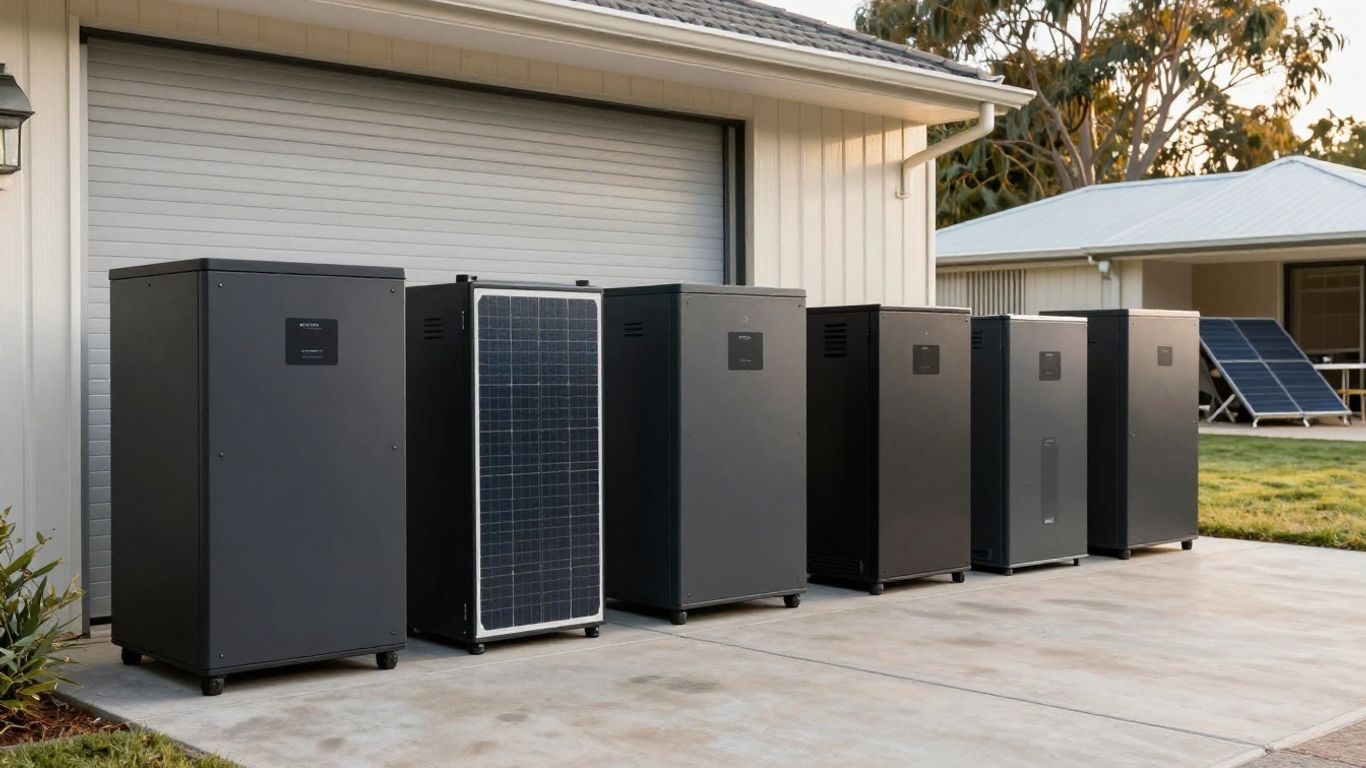
Lithium-ion batteries are widely used in residential energy storage because they can provide substantial capacity in a relatively compact enclosure. They generally suit households that want frequent daily cycling and a neat installation footprint. Their performance still depends on the particular product, controls, temperature range and warranty conditions.
Ask for both the nominal capacity and the usable capacity. Also check how the warranty treats cycling, throughput, retained capacity and operating conditions rather than assuming every lithium-ion battery has the same service life.
Lithium iron phosphate batteries
Lithium iron phosphate, often abbreviated to LFP or LiFePO4, is a lithium-based chemistry commonly considered for stationary storage. Buyers may value its emphasis on thermal stability and regular cycling, but the complete system remains the relevant unit: enclosure, battery management system, inverter and installation all matter.
The chemistry alone does not answer whether a particular product is suitable. Compare its usable energy, continuous power, surge capability, temperature limits and warranty with the demands of your home.
Lead-acid batteries
Lead-acid batteries have a long history in backup and off-grid applications and can have a lower initial purchase price. They are usually heavier and may offer less usable energy for a given nominal rating when the design requires conservative discharge. Ventilation, maintenance and placement can also be more significant considerations.
They may still make sense in some specialised systems, especially where simplicity or an existing design is a priority. For a daily residential cycling system, however, compare the full lifetime cost rather than focusing only on the initial quote.
Flow batteries and emerging options
Flow batteries store energy in liquid electrolytes held in tanks, separating energy capacity from some aspects of power delivery. They can be attractive for particular larger-scale or long-duration applications, although residential availability, installation complexity and cost vary. Other chemistries continue to develop, so product-level evidence matters more than a technology label.
A practical shortlist should include independent installation advice and a clear warranty. Do not choose an emerging option solely because its specification sounds innovative; confirm local support, replacement parts and service arrangements first.
Size a battery for your household’s needs
Battery sizing is an exercise in matching energy, power and timing. A battery that covers an average daily load may not run a kettle, heat pump or electric vehicle charger at the same time. Meanwhile, a large battery can be poor value if there is not enough surplus solar to charge it regularly.
Review your daily electricity consumption
Start with electricity bills and, where available, interval data from your retailer or smart meter. Look for daily consumption, evening demand and seasonal changes rather than relying on one unusually hot or cold day. Separate flexible loads, such as some appliance use or hot-water heating, from essential loads that occur at fixed times.
A simple household energy review should record:
- average daily consumption across several months;
- evening and overnight electricity use;
- major seasonal differences in heating or cooling;
- appliances that must operate during an outage.
This information gives an installer a more useful starting point than a guessed battery size. It also supports broader household budgeting, alongside practical Australian saving strategies for reducing recurring costs.
Match storage capacity to solar generation
The battery needs enough surplus solar to charge on ordinary days, not only on the brightest days of the year. Compare the expected solar generation profile with your daytime load and the amount of energy you want available after sunset. Oversizing storage can leave capacity unused, while undersizing may send more surplus to the grid than you expected.
Your retailer’s feed-in rate matters here. If exported energy is worth relatively little compared with evening grid electricity, storing more surplus may be useful. If the battery is rarely full, however, increasing capacity may not improve the outcome.
Account for peak loads and backup appliances
Capacity is measured in kilowatt-hours, while the ability to run appliances at a particular moment is measured in kilowatts. A battery might store enough energy for an evening but still need load management to start a pump or support several large appliances together. Ask for continuous output and surge output, not just storage capacity.
List the appliances that matter during a blackout and identify which can be switched off or delayed. This helps avoid paying for whole-home output when partial backup would meet the household’s practical needs.
Understand usable capacity and depth of discharge
Nominal capacity is the total amount a battery may hold under specified conditions. Usable capacity is the portion the system makes available for normal operation, while depth of discharge describes how much of the stored energy is used before recharging. These figures should be read together with efficiency and warranty assumptions.
The same battery can deliver different practical results depending on reserve settings, temperature, age and operating mode. Request a quote that clearly states usable kilowatt-hours and the assumptions behind any annual savings estimate.
Choose the right solar battery features
Once the basic size is clear, compare the features that affect everyday performance. Efficiency, power, monitoring, warranty support and system controls can matter as much as the battery’s headline capacity. A slightly smaller system with suitable output and clear service arrangements may be more useful than a larger system that is poorly matched to the home.
Round-trip efficiency and energy losses
Round-trip efficiency describes how much energy can be recovered after charging and discharging, allowing for conversion losses. Every storage system loses some energy in the process. Higher efficiency can improve the value of storing solar, particularly when the battery cycles frequently.
Check whether the quoted figure applies to the complete system or only the battery cell. Inverter losses, standby consumption and reserve settings can affect the result that a household actually sees.
Power output and surge capacity
Power output determines how many appliances can run simultaneously. Continuous output is relevant to ongoing loads, while surge capacity helps with the brief starting demands of some motors and compressors. If backup is a priority, provide the installer with a list of circuits and appliance ratings.
Do not assume that a high-capacity battery has high power output. Energy and power are separate specifications, and both need to match the home’s intended use.
Warranty periods and cycle limits
A warranty should explain the period covered, minimum retained capacity, cycle or throughput limits, operating conditions and what happens if the product fails. It is also worth checking who handles the warranty locally and whether labour, transport or replacement installation is included.
Read the exclusions carefully. A long calendar warranty may still have limits tied to energy throughput or operating temperature, while a shorter warranty may be accompanied by a different service arrangement.
Monitoring systems and smart energy controls
Monitoring can show solar generation, household consumption, battery state of charge, exports and grid imports. Good visibility makes it easier to spot unusual behaviour and understand whether the battery is following the intended schedule. Some systems can also coordinate with tariffs or controllable loads.
Ask how the data is accessed, whether the system needs an internet connection and what happens if communications fail. A simple, reliable monitoring interface is often more useful than a complicated feature set that no one checks.
Plan battery backup and energy independence
A battery can reduce grid use without providing backup during an outage. Those are related but separate goals, and the installation needs to be designed for both if you want them together. Clarify whether you want bill reduction, short-term resilience, extended backup or a pathway towards off-grid operation.
Select essential circuits for backup
Begin with the loads that protect health, safety, communication and basic comfort. Refrigeration, selected lights, internet equipment and medical devices may be more important than an electric oven or pool pump. The final circuit selection should account for starting currents and the battery inverter’s limits.
An essential-loads plan also makes an outage easier to manage. Households know what remains powered and can avoid accidentally draining the battery on non-essential appliances.
Decide between whole-home and partial backup
Whole-home backup is convenient but can require greater inverter output, more complex switchgear and a larger budget. Partial backup focuses available energy on selected circuits and may provide a more predictable result. Neither approach is automatically superior; it depends on the home and the intended outage experience.
Ask the installer to explain what happens when the battery reaches its reserve level. Some systems may retain a minimum emergency reserve, while others can be configured differently according to the equipment and controls.
Prepare for blackouts and grid outages
Confirm whether the system can isolate the home safely from the grid and how quickly backup supply starts. Solar panels may not continue operating during an outage unless the system has the required backup architecture. A battery may also stop supplying power if a fault or safety condition is detected.
Keep realistic expectations about outage duration. A battery sized for evening energy shifting may not support several days of poor weather, especially if heating, cooling or cooking loads remain high.
Evaluate off-grid requirements
Off-grid homes need a complete energy plan, including adequate solar generation, battery reserve, inverter capacity and a strategy for prolonged cloudy weather. A generator or another backup source may be considered where essential loads cannot be interrupted. Water pumping, refrigeration and communications often deserve particular attention.
Off-grid design is less forgiving than a grid-connected installation. Have the system modelled using local weather patterns and the household’s actual demand before committing to equipment.
Calculate costs, savings and payback
The financial case for a battery varies widely between homes. Installation price, solar surplus, electricity tariffs, export rates, usage patterns and battery life all affect the result. A trustworthy estimate should show the assumptions, not present one attractive payback period as a certainty.
Compare battery purchase and installation costs
Request an itemised quote covering the battery, inverter or inverter changes, switchboard work, backup hardware, monitoring, compliance paperwork and labour. Installation conditions can differ substantially between homes, particularly where wall space, cable runs or electrical upgrades are involved.
When comparing household energy spending more broadly, even unrelated purchase decisions can affect the budget. For example, Electro Depot Soldes is relevant only as a reminder to compare appliance efficiency and total ownership cost, not as a battery recommendation.
Assess time-of-use tariffs and feed-in rates
A time-of-use plan may make it worthwhile to store solar during the day and use it during an expensive evening period. Some households may also charge from the grid at a cheaper time, if their system and retailer allow it. Compare these possible savings with the value of exporting solar that would otherwise be sent to the grid.
Tariffs can change, so test the calculation under more than one reasonable price scenario. A battery that looks attractive under a short-term tariff may have a different result after a plan change.
Consider rebates and incentives in Australia
Australian rebates and incentive schemes can depend on the state or territory, system eligibility, installer accreditation, product requirements and installation date. Check the current official rules before signing a contract, and confirm whether the quoted price already includes any expected discount or certificate value.
Do not treat a rebate as guaranteed until eligibility has been checked. The installer should be able to explain the paperwork, but the household remains responsible for understanding the terms attached to the offer.
Estimate long-term savings and replacement costs
A payback model should include battery degradation, possible inverter replacement, service costs, tariff changes and the value of electricity exported. It should also distinguish financial savings from the non-financial value of backup power. Reliability may be worthwhile to one household even when the pure bill reduction is modest.
Keep a copy of the quote, warranty and commissioning records. If the system needs service years later, these documents can be more useful than an old sales estimate. For other household services, the same principle applies: for instance, Bundoora Family Dental Clinic is a reminder that ongoing care costs should be considered separately from the initial decision, not folded into an unrelated energy payback figure.
Arrange a safe and compliant installation
A battery is electrical equipment with meaningful energy stored inside it, so installation quality matters. The location, protection, isolation, cabling and commissioning all need to suit the product and the property. Use written documentation and ask questions before work begins, particularly when adding storage to an existing solar system.
Check Australian installation requirements
Australian electrical and battery installation requirements can involve national standards, state or territory rules, network requirements, product documentation and local approvals. Requirements may differ according to system type, location and whether backup circuits are included. Confirm the current rules rather than relying on an overseas installation video or an old quote.
The installer should explain required labels, isolation points, certificates and any notifications to the electricity distributor. Keep these records with the system manuals.
Choose a qualified battery installer
Ask for evidence of the relevant electrical licence, battery installation experience, insurance and product-specific training. Seek a detailed proposal that states the equipment model, usable capacity, inverter output, warranty responsibilities and expected commissioning process.
Get more than one quote where practical, but compare scope rather than choosing solely on price. A lower quote may omit switchboard work, backup equipment, monitoring or compliance tasks that another installer has included.
Plan battery placement and ventilation
The battery should be placed in an area permitted by the manufacturer and applicable Australian requirements, with suitable clearance, protection from hazards and access for inspection. Heat, moisture, flooding, impact risk and proximity to living areas may all affect the proposed location. Ventilation requirements depend on the chemistry and equipment design.
Do not move or enclose the battery after installation without professional advice. A tidy-looking location can still restrict cooling or access to isolation equipment.
Maintain and safely recycle the system
Use the manufacturer’s monitoring and maintenance guidance, keep the area clear, and investigate warning messages promptly. Periodic checks may cover connections, enclosures, firmware, isolation equipment and system performance. Never open a battery enclosure or attempt electrical repairs yourself.
When the battery reaches the end of its useful life, ask the installer or manufacturer about an approved collection and recycling pathway. Batteries should not be placed in household bins. The same careful approach to product choices applies across the home, including checking ingredients and packaging when selecting Oli6Goat snacks; different products have different disposal and use requirements.
Conclusion
Choosing batteries for storing solar power is a matter of matching technology, capacity, output and backup expectations to the way your household actually uses energy. Start with interval consumption data, compare the full installed cost and warranty, then use a qualified Australian installer to confirm safety and compliance. A measured decision will usually serve you better than the largest battery or the most impressive headline specification.
Frequently Asked Questions
Are solar batteries worth it in Australia?
They can be worthwhile for households with suitable solar surplus, high evening electricity use, low feed-in value or a strong need for backup. The answer depends on the installed cost, tariff, battery life and how often the system cycles.
How large should a home solar battery be?
Size it from actual daily consumption, solar surplus, evening demand and the appliances you want backed up. Compare usable capacity and power output rather than relying on nominal kilowatt-hours alone.
Can a solar battery power a house during a blackout?
Only if the system is designed and installed for backup operation. It generally needs safe grid isolation, suitable inverter capability and either whole-home or selected essential circuits.
What is the difference between battery capacity and power output?
Capacity describes how much energy the battery stores, measured in kilowatt-hours. Power output describes how much electricity it can supply at one time, measured in kilowatts.
How long do solar batteries last?
Service life varies with chemistry, cycling, temperature, operating settings, product quality and warranty conditions. Check the expected retained capacity, cycle or throughput limits and replacement terms.
Can solar panels charge a battery during a power outage?
Some systems can continue charging from solar during an outage, but only when the equipment includes the required backup and isolation design. Standard grid-connected solar systems may shut down for safety.
What should I ask a battery installer?
Ask about usable capacity, continuous and surge output, backup circuits, placement, compliance paperwork, monitoring, warranty support, maintenance and end-of-life recycling. Request those details in writing before approving the installation.