

Key Takeaways
Choosing a portable lithium battery starts with the devices you need to run, not the biggest number on the box.
- Match watt-hours to your actual devices and expected runtime.
- Check ports, inverter output, charging inputs and surge capacity.
- Compare lithium-ion and LiFePO4 according to weight, lifespan and budget.
- Treat temperature, transport and certification requirements as part of the purchase.
- Store, charge and recycle the battery carefully to extend its useful life.
Understand what a portable lithium battery is and how it works
A portable lithium battery stores electrical energy in rechargeable cells and releases it through one or more outputs. The same broad idea covers a small battery pack for a phone and a larger portable power station for camping or short-term backup. Understanding the difference helps you avoid buying a unit that is either too limited or unnecessarily heavy.
Battery cells, packs and battery management systems
Individual lithium cells are combined into a pack to reach the required voltage and capacity. A battery management system monitors conditions such as cell voltage, temperature and charging behaviour, then helps protect the pack from faults. The quality of that system matters because the battery is not just a collection of cells; it is an electrical system that needs controlled charging and discharge.
A well-designed unit should also include protection against short circuits, overcurrent and excessive temperature. These safeguards do not make careless use safe, but they provide an important layer of control when the battery is operated within the manufacturer’s instructions.
Portable lithium batteries versus power banks
A power bank is generally designed for smaller electronics, with USB outputs and a compact shape suited to a backpack or pocket. A broader portable lithium battery may include USB, DC or AC outputs and enough capacity for equipment beyond a phone or tablet. The terms overlap in everyday speech, so read the specifications rather than relying on the product name.
For a phone, camera or earbuds, portability and USB charging may be all that matters. For a laptop, medical device or small appliance, you will need to examine output wattage, connectors and expected runtime as well.
Portable batteries versus power stations
A portable power station is usually a larger battery system with an inverter, several output types and multiple ways to recharge it. It can be useful at a campsite, in a caravan or during a brief outage, although its capabilities vary considerably between models. This portable power station guide provides a useful explanation of batteries, inverters and output ports.
The practical distinction is scale and flexibility. A small pack is easy to carry and ideal for personal electronics, while a power station trades some portability for more capacity and the ability to support higher-draw equipment.
Common applications around the home and outdoors
Common uses include keeping phones and laptops going while travelling, powering lights at a campsite, running small 12-volt equipment and maintaining essential communications during an outage. Some people also use portable batteries with cameras, portable refrigerators or audio equipment. The right choice depends on the device list, the length of time away from mains power and how far you need to carry the unit.
For Australian road trips, the battery should be considered alongside vehicle preparation, offline navigation and water planning. A practical outback travel guide can help put the power requirement into the wider context of remote travel.
Match battery capacity to your power needs
Capacity is where many buying decisions go wrong. A large watt-hour figure can look reassuring, but it does not tell you whether the outputs suit your equipment or whether the unit will be manageable to transport. Start by listing what you will power, how often you will use it and which items must keep working.

Reading watt-hours, amp-hours and voltage
Watt-hours, written as Wh, are the simplest comparison for a portable system because they describe stored energy. Amp-hours, or Ah, only become meaningful when paired with voltage: watt-hours equal amp-hours multiplied by volts. Check whether a manufacturer is quoting nominal capacity, rated capacity or usable capacity, as those figures may differ.
As a rough example, a 100 Wh battery theoretically stores twice the energy of a 50 Wh battery. That does not guarantee twice the runtime in practice, because conversion losses and the device’s own charging behaviour reduce the energy available at the socket.
Estimating runtime for phones, laptops and appliances
Estimate runtime by dividing usable watt-hours by the device’s average draw in watts. A 60 W appliance connected to a battery with 300 usable Wh might run for about five hours before losses and reserve limits are considered. Chargers and appliances often draw less than their maximum rating, but it is safer to plan around realistic or measured consumption.
For phones and laptops, the battery’s Wh figure can be compared with the device battery after allowing for charging losses. For appliances, look for a wattage label and consider whether the load cycles on and off rather than running continuously.
Allowing for inverter losses and standby consumption
An AC inverter changes the battery’s DC electricity into household-style AC power, and that conversion uses energy. The inverter may also consume a small amount while switched on, even when the connected appliance is idle. That is why a device connected through USB can run longer than the same device powered through an AC adaptor.
Build a margin into your calculation rather than treating the label as a promise. Leave room for losses when comparing models, particularly if your intended load includes an inverter, refrigeration or equipment with a motor.
Choosing capacity for camping and emergency backup
Camping usually rewards a balance between enough energy for lights, phones and selected appliances and a weight you can comfortably move. Emergency backup calls for a more deliberate priority list: communications, lighting, refrigeration, medical equipment and internet access may matter more than convenience loads. If you are planning for a household, calculate each essential device separately rather than choosing by size alone.
A simple capacity table can make the decision less abstract:
| Intended use | Typical priority | What to check |
|---|---|---|
| Weekend camping | Phones, lights, cameras | USB and DC outputs, manageable weight |
| Remote road trip | Communications and small appliances | Recharge options and vehicle compatibility |
| Short outage | Router, lights and essential devices | Usable Wh and continuous AC output |
| Longer backup | Multiple household essentials | Expandability, solar input and recharge time |
Use the table as a starting point, then replace general assumptions with the actual ratings of your equipment. If the battery will sit in a car or shed, storage temperature and ventilation deserve attention too.
Compare lithium battery chemistries
Lithium battery chemistry affects weight, cycle life, thermal behaviour and price. The chemistry is only one part of the product, but it helps explain why two batteries with similar capacity can have different dimensions and warranties. Consider the pattern of use rather than treating one chemistry as universally best.
Lithium-ion batteries for everyday portability
Conventional lithium-ion packs are widely used in portable electronics because they can provide useful energy without excessive weight. They are often a sensible fit for travellers who value a compact charger for phones, tablets, cameras or laptops. Their practical appeal is strongest when the battery is carried frequently and used for modest loads.
Always compare the complete specification, including rated capacity, protection features, charging time and supported outputs. Chemistry alone cannot tell you whether a particular product is suitable for a laptop or appliance.
LiFePO4 batteries for longevity and safety
Lithium iron phosphate, commonly called LiFePO4 or LFP, is used in many larger battery systems. It is often selected for its potential cycle life and stable thermal characteristics, though the finished product still depends on cell quality, battery management and operating conditions. A LiFePO4 pack may be heavier than a comparable lithium-ion pack, so the benefit needs to fit your use case.
If you expect frequent cycling for camping or backup, cycle-life information may matter more than the lightest possible design. Treat published cycle figures as test-based specifications, not a guarantee of identical results in every home or climate.
Weight, size and usable capacity trade-offs
A light battery is easier to take on a plane, carry between a car and campsite or keep in a day bag. A larger unit may provide more usable energy, stronger AC output and better support for solar or expansion, but it can become awkward before it becomes useful. Consider the route from the vehicle to the place where the battery will actually operate.
The shape matters as well. A stable base, protective casing and a practical handle can make a heavier unit safer to move than a smaller battery with poor ergonomics.
When a higher upfront cost is worthwhile
Paying more can make sense when the battery will be cycled often, exposed to demanding conditions or relied on during outages. Look at the warranty, expected cycle life, repair or replacement pathway and charging options alongside the purchase price. For occasional travel, a simpler and smaller unit may offer better value.
The same measured approach applies to other technology purchases. A guide to the smartphone landscape is a reminder that battery size, charging standards and durability need to be assessed together rather than in isolation.
Check the outputs, inputs and device compatibility
A battery can have plenty of capacity and still be wrong for your equipment. Before purchasing, list each device’s connector, input voltage, normal power draw and any startup surge. Then compare those requirements with the ports and limits printed in the battery’s manual.
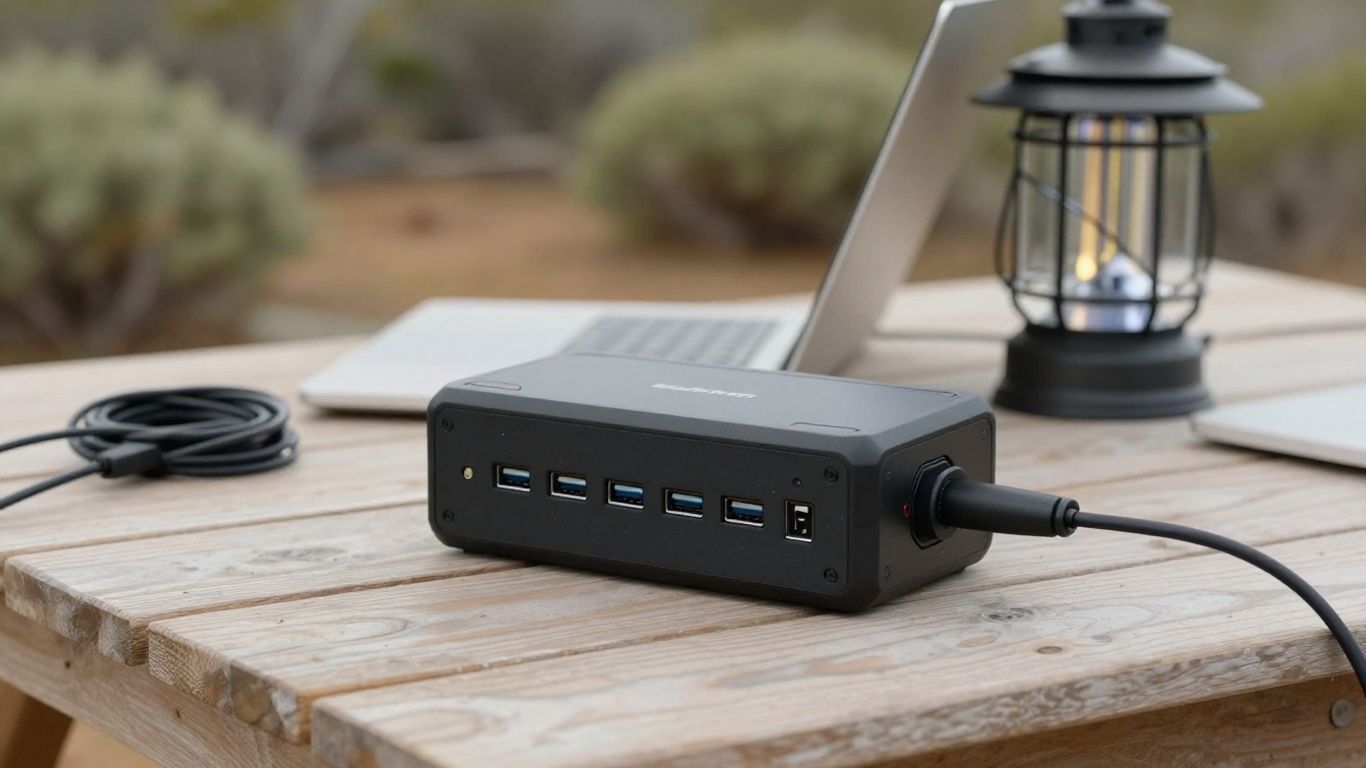
USB-A, USB-C and fast-charging requirements
USB-A remains useful for older cables and accessories, while USB-C can support newer phones, tablets and laptops. A USB-C port is not automatically a fast charger: check its power delivery rating and whether the cable and device support the same standard. A phone may charge slowly if the port cannot provide the required profile.
The same caution applies to laptops. Confirm both the wattage and charging protocol, especially if you intend to work away from mains power for a full day. This is also where the topic overlaps with modern mobile devices, whose charging and battery needs vary between models.
AC outlets and inverter capacity
AC outlets are convenient because they accept familiar household plugs, but the inverter has a finite output. Check its continuous watt rating and whether the waveform is suitable for your equipment. An AC outlet may be unnecessary for a USB device, and using it can reduce runtime through conversion losses.
Do not assume that a higher-capacity battery automatically has a stronger inverter. Capacity tells you how much energy is stored; inverter output tells you how quickly and in what form that energy can be delivered.
DC sockets, solar input and car charging
DC outputs can be efficient for compatible lights, fridges and other equipment because they avoid an AC conversion step. Solar input specifications are equally important: check the supported voltage range, maximum current and connector type before pairing a panel. Car charging can be convenient on a road trip, but recharge speed depends on the vehicle, cable and battery input limit.
Keep the cables organised and label unusual connectors if several people will use the setup. A mismatch can stop charging or, in some cases, damage equipment.
Continuous watts versus surge watts
Some devices, particularly motors, compressors and pumps, draw more power briefly when starting. Continuous output describes what the inverter can sustain, while surge output describes a short peak. A battery needs enough of both, and the duration of the surge matters.
Check the appliance manual rather than guessing from its running wattage. When a device has a high startup demand, choose a battery with a clearly stated surge rating and suitable protection behaviour.
Prioritise safety, transport and Australian requirements
Lithium batteries are useful, energy-dense devices, so safe handling is part of choosing well. Read the product manual before charging, inspect the casing after transport and stop using a battery if it is swollen, cracked, unusually hot or giving off an odour. Australian conditions add another practical concern: a closed vehicle or shed can become much hotter than the surrounding air.
Built-in protection against overheating and overcharging
Look for a battery management system that documents protection against overcharge, over-discharge, overcurrent, short circuit and excessive temperature. These features help manage normal operation, but they cannot compensate for damaged cables, an unsuitable charger or a modified pack. Do not bypass protective electronics or use an unapproved power supply.
The product page and manual should explain the limits clearly. Vague claims about safety are less useful than a documented specification and a manufacturer that provides support information.
Safe charging, storage and operating temperatures
Charge the battery on a stable, non-combustible surface with room around vents and controls. Avoid charging or using it in direct sun, near heaters or in damp conditions unless the product is specifically rated for that environment. For storage, follow the recommended charge level and check the unit periodically rather than leaving it unattended indefinitely.
A battery that has been exposed to extreme heat or cold should return to an appropriate temperature before charging. If it behaves unusually, disconnect it and seek manufacturer advice.
Airline rules and limits for spare lithium batteries
Airline rules can limit spare lithium batteries according to watt-hours, terminal protection and whether the battery is carried in cabin baggage. Rules vary by airline and route, and larger portable power stations may not be accepted as ordinary carry-on items. Check the current requirements directly with the airline before travelling.
The air travel lithium battery guidance is useful background, but it should not replace confirmation from your airline. Never put a loose spare battery in checked baggage unless the carrier explicitly permits that specific arrangement.
Checking product certification and manufacturer guidance
Look for clear electrical ratings, relevant Australian compliance information, a traceable manufacturer and instructions written for the exact model. Be cautious when the listing does not state capacity, output limits, charging conditions or warranty terms. Documentation is especially valuable when the battery will be used in a home, caravan or workplace.
Do not confuse a marketing badge with independent certification. Keep the receipt, manual and model number together so you can check recalls or obtain support later.
Choose features for your intended use
Once capacity, chemistry and compatibility are clear, features can help narrow the shortlist. They should solve a real problem rather than simply make the specification sheet look impressive. Think about weather, monitoring, recharging and how often the unit will be moved.
Weather resistance and outdoor durability
A rugged case can protect against knocks, dust and splashes, but “rugged” does not always mean waterproof. Check the stated ingress rating and keep ports covered when they are not in use. Even a weather-resistant battery should be kept out of standing water and protected from unnecessary exposure.
For camping, examine the feet, handle, display cover and cable storage as well as the shell. Small design details often affect whether the battery remains usable after a dusty weekend.
Displays, mobile apps and battery monitoring
A display can show remaining percentage, input, output and estimated runtime without requiring a phone. An app may add remote monitoring, alerts or settings, but it can also introduce another dependency when reception is poor or a phone battery is low. Choose the level of information you will actually use.
A percentage estimate is not a laboratory measurement. Treat it as a guide, especially when the load changes or the battery is powering an inverter.
Expandable capacity and solar charging
Some systems allow additional batteries or solar panels to be added later. Expansion can be worthwhile if your needs may grow, but check whether the extra units must match a specific model and whether the combined system has new weight or charging limits. Solar charging is also affected by panel position, cloud, shade and the input ceiling of the battery.
For a simple weekend setup, expansion may add cost and complexity without much benefit. For a semi-permanent backup arrangement, it can provide a more adaptable path than replacing the entire system.
Portability, handles and practical weight
Read the net weight and dimensions, then imagine lifting the battery into a boot, over uneven ground or onto a camp table. Wheels can help with larger systems, while a firm handle matters on smaller ones. A battery that stays at home has different portability requirements from one carried between train stations and accommodation.
A useful final check is to compare the battery with the gear it will accompany. If the unit requires a separate trolley or awkward lifting technique, its headline capacity may not reflect its real convenience.
Extend the life of your portable lithium battery
Good care protects both performance and safety. The most effective habits are unglamorous: use the correct charger, avoid extreme temperatures, keep the ports clean and store the battery according to its instructions. These steps are more valuable than chasing small differences between headline specifications.
Best charging and storage practices
Use the supplied charger or an approved replacement with the correct voltage and current. Do not leave the battery charging in a hot car or under bedding, and disconnect it when the manual says charging is complete. If the unit will not be used for several months, store it at the recommended charge level and inspect it occasionally.
Keep records of unusual behaviour, such as a sudden capacity drop or a charger that becomes hot. Those details can help a service team diagnose a problem early.
Avoiding deep discharge and excessive heat
Repeatedly running a battery completely flat can place extra stress on the cells, particularly when it then sits empty for an extended period. Recharge it before it reaches a critically low level where practical, and reduce the load if the unit becomes unusually warm. Heat is one of the most avoidable causes of accelerated battery ageing.
Do not use a portable battery inside a sealed container while it is charging or powering a large load. Ventilation and clearance around the unit should match the manual’s instructions.
Cleaning, inspection and cable care
Switch the battery off before cleaning and use a dry or lightly damp cloth, never a hose or solvent. Inspect the casing, ports, plugs and cables for cracks, bent contacts, fraying or signs of moisture. Store cables without sharp bends and keep grit away from connectors.
If a port is loose or a cable has been damaged, stop using that connection rather than forcing it. A small inspection before a trip can prevent a much larger inconvenience away from home.
Recycling and responsible end-of-life disposal
Do not place a lithium battery in household rubbish or a kerbside recycling bin. Damaged or discarded batteries can create fires in collection and sorting systems. Contact your local council, an approved battery collection service or the retailer for current disposal options in your area.
Tape exposed terminals and keep a damaged battery isolated from flammable materials while arranging advice. Never dismantle, puncture or burn the pack yourself.
Conclusion
The right portable lithium battery is the one that matches your devices, travel plans and charging habits without creating unnecessary weight or complexity. Compare usable capacity, outputs, chemistry, safety information and transport requirements together, then choose the smallest system that comfortably covers your genuine needs.
Frequently Asked Questions
What is a portable lithium battery?
It is a rechargeable battery system designed to store energy and deliver it through outputs such as USB, DC or AC. The size and capability can range from a small phone power bank to a larger portable power station.
How many watt-hours do I need?
Add the wattage and expected operating time of the devices you plan to run, then allow for inverter and charging losses. Choose a capacity with a sensible margin rather than relying only on a device’s maximum rating.
Is LiFePO4 better than lithium-ion?
Neither is automatically better for every use. LiFePO4 can suit frequent cycling and larger systems, while conventional lithium-ion can be attractive when low weight and compact size are priorities.
Can a portable lithium battery run a fridge?
Some can, provided the battery has enough usable capacity, suitable continuous output and adequate surge capacity for the compressor. Check the fridge’s starting demand and the battery’s inverter specifications.
Can I take a portable lithium battery on a plane?
Possibly, but airline and aviation rules depend on watt-hours, battery type, terminal protection, baggage location and carrier policy. Confirm the current requirements with the airline before travelling.
How should I store a lithium battery?
Store it in a cool, dry place away from direct sunlight and flammable materials, using the charge level recommended by the manufacturer. Inspect it periodically if it will remain unused for a long time.
When should a lithium battery be replaced?
Consider replacement when capacity has fallen substantially, the casing is damaged or swollen, the battery overheats, or charging and output behaviour becomes abnormal. Stop using a damaged battery and arrange professional advice or approved recycling.